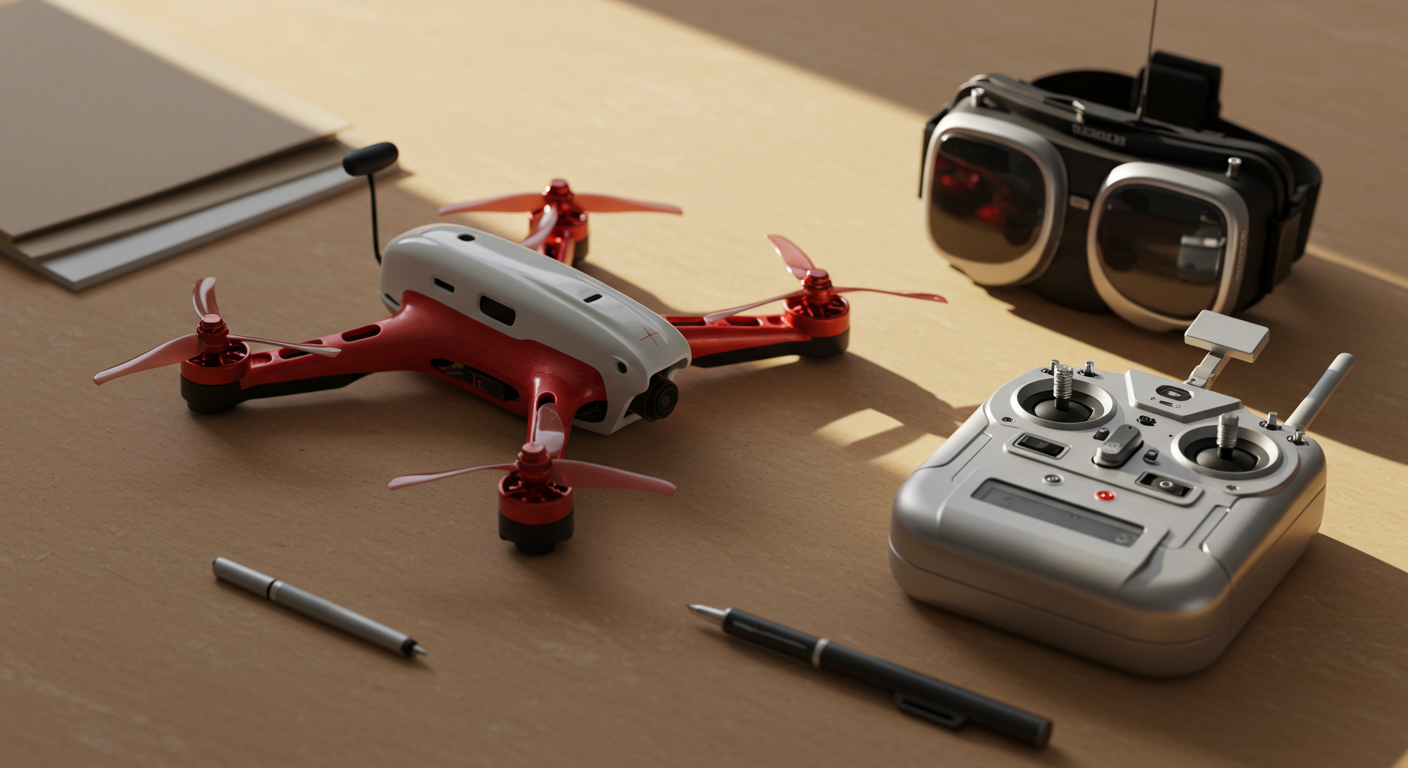
FPV drone jargon trips up almost every beginner: O4, ELRS, ArduPilot, VLOS, RTH. None of it is complicated once it is explained in plain English, and knowing the words makes buying — and flying — far less daunting. This glossary defines the terms a UK newcomer actually meets, grouped by what they relate to: the video link and goggles, the control radio, the flight software, the flying styles, and UK drone law. Read it once and the spec sheets stop looking like another language.
Video link and goggles
The video link is what makes a drone “FPV”: a live picture beamed from a camera on the drone to a screen on your face, so you fly as if you were sitting in the cockpit. The quality and delay of that link matter more than almost anything else, because you are flying on it in real time. Modern digital systems give a sharp, stable HD picture; older analogue gave a softer, static-prone image. A few seconds of jargon here saves a lot of confusion when you compare drones and goggles, because most of the headline specs you will see describe this video chain rather than the airframe itself.
- FPV (first-person view) — flying a drone using a live camera feed shown in goggles or on a screen, rather than watching the aircraft from the ground. It is the immersive, “in the cockpit” way to fly. Wikipedia has a fuller history if you want the background.
- DJI O4 — DJI’s current digital video transmission system, used by both MemAero drones. It sends a low-latency HD feed to DJI goggles. “O4 Pro” is the higher-end version on the larger model.
- Goggles — the headset that displays the live feed. MemAero drones work with DJI Goggles N3 and Goggles 3 out of the box; we cover the difference in our goggles comparison.
- Latency — the delay between something happening in front of the drone and you seeing it in the goggles. Lower is better; digital systems like O4 keep it low enough to fly fast.
- Analogue vs digital — analogue is the old, cheap video standard (soft picture, breaks up with static); digital (like O4) is crisp HD. New pilots should expect digital.
Control: the radio link
Separate from the video, a second radio link carries your stick movements from the handset to the drone. It is the channel that actually flies the aircraft, so its range and reliability decide how far and how safely you can go. The standard most new drones use today is ELRS, an open system known for long range and a strong connection. You will also see the word “failsafe”, which is what the drone does if that link drops — a sensible failsafe is the difference between a drone that flies itself home and one that falls out of the sky. Understanding the control link helps you judge a drone’s real-world range claims rather than taking a headline number at face value.
- ELRS / ExpressLRS — the popular open-source long-range control link both MemAero drones use. Reliable, low-latency, and supported by most modern radios.
- Crossfire (TBS) — an earlier long-range control system; capable, but ELRS has largely become the default for new builds.
- Radio / transmitter (TX) — the handset you hold. It sends your control inputs to the drone over the control link, and doubles as your simulator controller.
- Failsafe — the pre-set behaviour if the control link is lost: a good drone holds position or flies home rather than crashing.
Flight software and safety features
The flight controller runs firmware that decides how the drone behaves and what safety nets it offers. This is where MemAero differs from a bare racing quad: our drones run open-source ArduPilot, which adds genuinely useful autonomy — the drone can hold its position, return to you on its own, and fly planned routes. For a nervous beginner these features are the safety net that makes learning realistic; for a creator they make repeatable, cinematic shots possible. We explain why this matters in why FPV drones should run ArduPilot. Knowing these terms lets you tell a forgiving, capable drone from a raw one that demands expert sticks from the first second.
- ArduPilot — the open-source flight firmware MemAero uses. It unlocks GPS autonomy, waypoint missions and tuning, and you can reprogram it — you own the aircraft.
- Betaflight — the firmware most pure racing/freestyle quads use. Excellent for manual acro flying, but without the GPS-assisted safety modes ArduPilot offers.
- Position Hold — using GPS, the drone holds its spot in the air when you let go of the sticks. The single most reassuring feature for a beginner.
- Return-to-Home (RTH) — the drone flies back to its launch point automatically, triggered by a low battery, a lost signal, or a button. It is why you are far less likely to lose the aircraft.
- Waypoint navigation — planning a route on a map that the drone then flies on its own, useful for repeatable cinematic shots or surveys.
Flying styles (disciplines)
FPV is not one activity. The word covers several disciplines, and the right drone depends on which one appeals to you. Freestyle is the acrobatic, expressive flying most people picture; cinematic is smooth, flowing footage; long-range is about covering distance and landscape; racing is competitive gate-to-gate flying. A 5-inch drone like the Aero 2 suits freestyle and learning; a 7-inch drone like the Aero 3 suits long-range and cinematic work. If you are still deciding, our racing vs freestyle vs cinematic guide and getting-started guide map styles to gear and skill level so you choose once and choose well.
- Freestyle — expressive, acrobatic flying (flips, rolls, dives). Usually a nimble 5-inch drone.
- Cinematic — smooth, flowing footage prioritising image quality and steady movement over speed.
- Long-range — efficient cruising to cover distance and capture landscape; favours a larger 7-inch airframe and efficient props.
- Racing — competitive, gate-to-gate flying at speed, typically on light, purpose-built 5-inch quads.
UK law terms you must know
A handful of legal terms decide what you are allowed to do, and they are simpler than the acronyms suggest. In the UK, recreational FPV is legal when flown within line of sight, and both MemAero drones need two free CAA registrations before the first flight. The terms below are the ones every UK pilot should recognise; we cover them in depth, with the current rules, in are FPV drones legal in the UK. Getting these right is not optional — flying an unregistered drone can mean a fine — but it is quick and free to do, and knowing the vocabulary makes the official guidance far easier to follow.
- VLOS (Visual Line Of Sight) — you must keep the drone within your own unaided sight at all times. UK recreational flying is VLOS only.
- BVLOS (Beyond Visual Line Of Sight) — flying further than you can see; not permitted for recreational pilots without specific CAA authorisation.
- Flyer ID — a free CAA online theory test proving you know the basics. Free, takes under an hour, no minimum age.
- Operator ID — free CAA registration of the person responsible for the drone; required for any drone over 100g, and displayed on the aircraft. Register at the CAA drone registration service.
- 100g threshold — the UK registration threshold. Any drone over 100g (which includes both MemAero models) needs a Flyer ID and Operator ID. See the CAA Drone and Model Aircraft Code.
Frequently asked questions
What does FPV stand for?
FPV stands for first-person view. It means flying a drone using a live camera feed shown in goggles or on a screen, so you see what the drone sees in real time rather than watching it from the ground.
What is the difference between ArduPilot and Betaflight?
Betaflight is the firmware most racing and freestyle quads use for manual flying. ArduPilot, which MemAero uses, adds GPS-assisted autonomy — Position Hold, Return-to-Home and waypoint missions — and is fully open and reprogrammable, so it suits pilots who want safety nets and ownership.
What does ELRS mean on an FPV drone?
ELRS (ExpressLRS) is the open-source long-range control link that carries your stick inputs from the handset to the drone. It is reliable, low-latency and the modern default; both MemAero drones use it.
What is the 100g rule for drones in the UK?
In the UK, any drone over 100g must be registered: the operator needs a free CAA Operator ID and the pilot needs a free Flyer ID. Both MemAero drones are over 100g, so both require registration before flying.
Do I need to understand all this jargon to start FPV?
No. You need the basics — FPV, goggles, the control link, the safety modes, and the UK law terms. The rest you pick up as you fly. Our getting-started guide walks a complete beginner through the path from simulator to first flight.