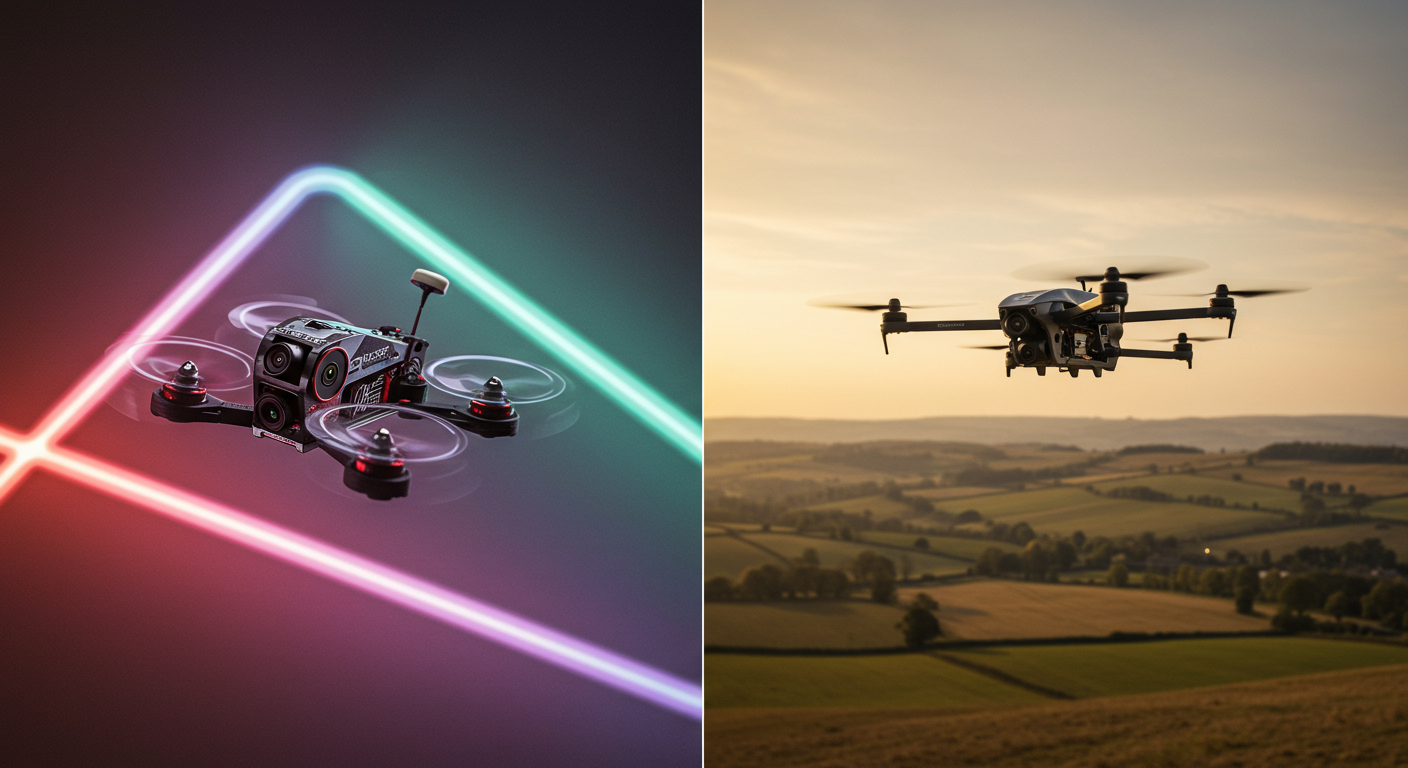
There are three distinct disciplines in FPV drone flying — racing, freestyle, and cinematic — and choosing the wrong one as your entry point is the single most common reason new pilots spend money on the wrong gear. Racing prioritises outright speed and precision lap times on a defined course. Freestyle uses the whole sky as a canvas for aerial acrobatics and trick sequences. Cinematic FPV trades raw aggression for smooth, controlled camera motion to produce striking video footage. Each discipline has different gear requirements, different skill priorities, and a different community culture — and knowing which you are drawn to before buying saves you from the most expensive mistake in the hobby.
FPV racing: speed, precision, and lap times
FPV racing is exactly what it sounds like: piloting a drone around a defined course of gates and flags, as fast as possible, in first-person view. Racing quads are typically 3-inch to 5-inch builds, stripped of any unnecessary weight, running Betaflight in Acro mode for maximum responsiveness. The British FPV racing community is active, with organised events through the FPVUK association and informal club racing taking place at fields across the country. Racing demands the sharpest reflexes of the three disciplines; a racing pilot spends most of their early months in a simulator developing split-second throttle management through gates. The gear is purpose-built and relatively uncompromising — a pure racing quad makes a poor freestyle or cinematic machine because every decision in its design trades versatility for lap-time performance.
Freestyle FPV: aerial acrobatics and creative expression
Freestyle is the most popular FPV discipline by volume of participants, and the one that the MemAero Aero 2 is most naturally aligned with. A freestyle pilot uses an open flying area — a park, an industrial site with permission, a field — to perform sequences of rolls, flips, power loops, split-S turns, and longer flowing lines. The footage, typically recorded on a GoPro or integrated camera, is edited into YouTube and Instagram reels that showcase both the pilot's skill and the creative vision behind the session. A good 5-inch freestyle drone has enough thrust to recover from any attitude, enough weight to hold a line in wind, and enough camera quality to produce watchable footage. The MemAero Aero 2 — 5 inches, approximately 450 g, integrated 4K/60fps camera, ArduPilot firmware — is a production-grade freestyle platform that grows with the pilot: begin in assisted Angle mode and graduate to full Acro as your skills demand.
Cinematic FPV: smooth motion, controlled lines, professional footage
Cinematic FPV is the fastest-growing corner of the hobby and increasingly overlaps with professional commercial work. The goal is not tricks but controlled, aesthetically deliberate movement — an arc through a gorge, a low-altitude chase of a vehicle, a smooth orbit around a subject. Cinematic pilots prioritise camera quality, flight time, wind resistance, and GPS-assisted smoothness over raw agility. This is where a 7-inch platform comes into its own. The MemAero Aero 3 — 7 inches, approximately 720 g, 4K/120fps 10-bit DJI O4 Pro video, dual-band ELRS for extended range, up to 17-minute flight time — is designed precisely for this discipline. Its ArduPilot firmware adds Position Hold and waypoint missions for repeatable, consistent shots that would be impossible to execute consistently on a manual-only platform.
Gear differences: what each discipline demands
| Discipline | Typical frame size | Key firmware feature | Camera priority | MemAero match |
|---|---|---|---|---|
| Racing | 3–5 inch | Low-latency Acro (Betaflight) | Race cam (latency over quality) | Not the primary Aero 2 use case |
| Freestyle | 5 inch | Acro + optional Angle mode | Integrated HD cam or GoPro | Aero 2 (5", 450 g, 4K/60fps) |
| Cinematic | 5–7 inch | Position Hold, waypoints, GPS | High-bitrate, high frame rate | Aero 3 (7", 720 g, 4K/120fps 10-bit) |
Which discipline should a beginner choose?
For most beginners the answer is freestyle, entered via a 5-inch ArduPilot platform. Racing requires a very specific skill set built almost entirely in a simulator; committing to racing before developing basic aircraft control often leads to frustration and expensive crashes. Pure cinematic work requires confident aircraft handling before the subtleties of framing and movement become teachable — you cannot compose a beautiful shot if you are still concentrating entirely on not crashing. Freestyle occupies the productive middle ground: the skills you develop — smooth lines, controlled orientation, recovery from unusual attitudes — transfer directly to both racing and cinematic work later. Start on a 5-inch freestyle machine, build your hours, then specialise. The MemAero beginner guide walks through this progression in detail.
How UK drone law applies across the disciplines
All three disciplines are subject to the same UK CAA regulations. Any drone over 100 g — which includes the Aero 2 and Aero 3 — requires a registered Operator ID and a Flyer ID for pilots aged 13 and over. Racing clubs often operate on private land under specific permissions; freestyle pilots typically fly in open recreational areas within the operational limits of the UK Air Navigation Order. Cinematic operators intending to fly near people or for commercial purposes may need to progress to a GVC (General Visual Line of Sight Certificate) qualification. Whichever discipline you choose, the legal framework is the same starting point.
Frequently asked questions
What is the easiest FPV discipline for a beginner to learn?
Freestyle is generally the most accessible entry point because it does not require a dedicated racing track or the hyper-precise reflexes of competitive racing, and it does not demand the camera and movement control of cinematic work. A beginner can develop meaningful skills with a 5-inch freestyle drone on any open patch of ground.
Do I need different drones for racing, freestyle, and cinematic?
In practice, yes. Racing builds prioritise low weight and maximum responsiveness at the expense of camera quality and durability. A 5-inch freestyle drone like the Aero 2 can double as a capable beginner racing machine but is not optimal for gate racing. A 7-inch cinematic platform like the Aero 3 is too large and heavy for competitive racing. The good news is that a single freestyle drone covers the vast majority of what most hobbyists will ever want to do.
What is the difference between a 5-inch and a 7-inch FPV drone?
The inch measurement refers to propeller size. A 5-inch drone like the Aero 2 is lighter (approximately 450 g), more agile, and easier to transport. A 7-inch drone like the Aero 3 is heavier (approximately 720 g), flies longer (up to 17 minutes), carries a higher-quality camera (4K/120fps 10-bit), and is more stable in wind — making it better suited to cinematic and long-range missions.
What is cinematic FPV and how is it different from a DJI camera drone?
Cinematic FPV uses a traditionally-configured FPV quad (pilot looks through goggles) flown at higher speed and through more dynamic paths than a stabilised camera drone like a DJI Air 3. The result is footage with unique energy and movement that a conventional camera drone cannot replicate. The Aero 3's 4K/120fps 10-bit capability sits between the two worlds: full FPV agility with near-broadcast image quality.
Can I race an ArduPilot drone?
Yes. ArduPilot supports Acro mode with tuning options comparable to Betaflight for non-competitive and casual club racing. For elite league-level racing where milliseconds matter, the community typically uses Betaflight. For everything else — freestyle, casual racing, cinematic work, and long-range exploration — ArduPilot is the more capable platform.
Is freestyle FPV legal in the UK?
Yes, provided you comply with CAA regulations: hold a Flyer ID and Operator ID (both free), fly within visual line of sight, and observe the restrictions of the operational category your drone falls into. Any drone over 100 g must be registered. The MemAero FAQ page covers the key rules in plain English.