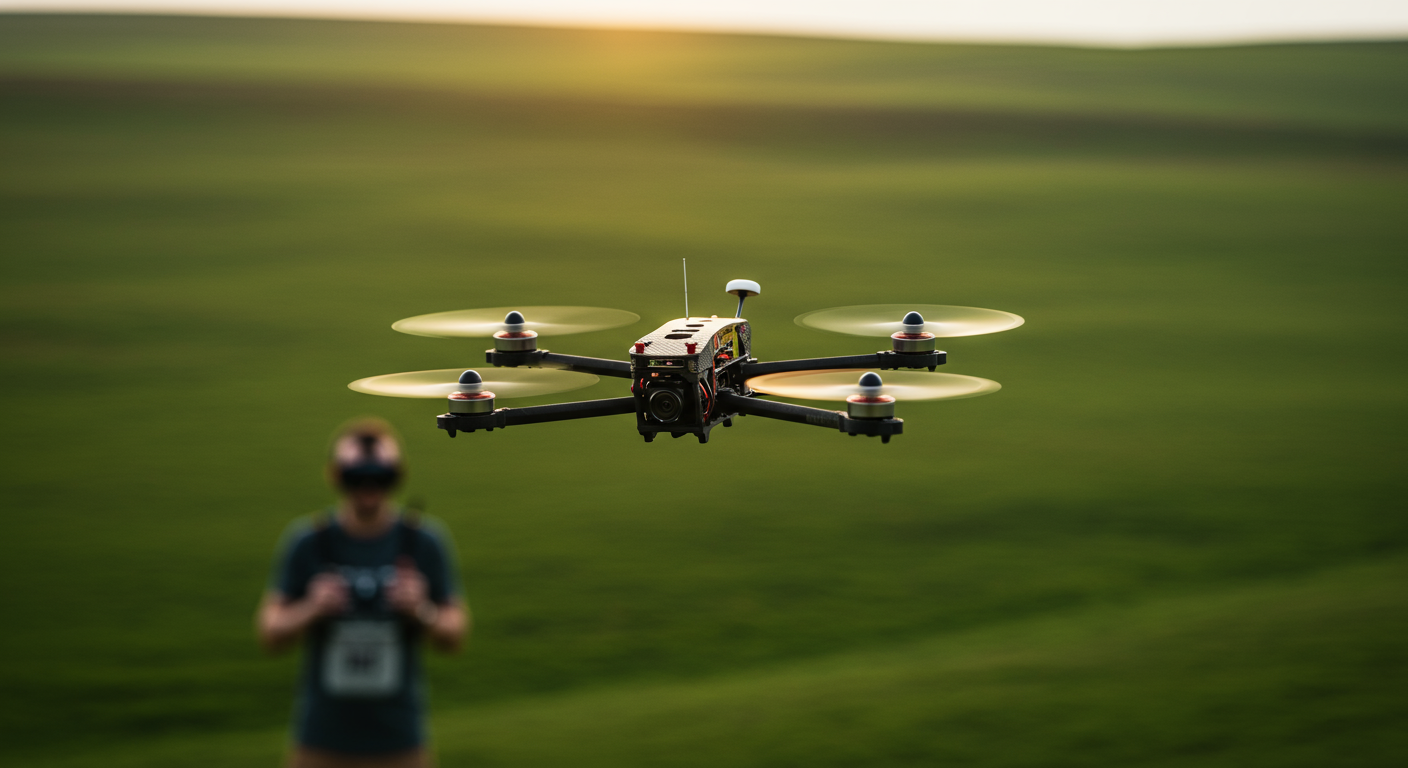
The best FPV drone for beginners in the UK in 2026 is a 5-inch, ready-to-fly machine with stabilised flight modes, open firmware, and genuine repairability — because you will crash, you will want to improve, and the drone needs to grow with you rather than become a paperweight the moment your skills outpace it. Three years of community data consistently point to one conclusion: beginners who start on a sim and progress to a mid-sized stabilised 5-inch like the MemAero Aero 2 reach solo, confident flight in a fraction of the time compared with those who buy the cheapest whoop or, conversely, the most aggressive race build.
What a beginner actually needs from an FPV drone
New flyers need two things above everything else: a drone that is physically safe to learn on and one that does not require rebuilding after every hard landing. Tiny whoops are popular starter recommendations because they are light and relatively harmless indoors, but they teach unrealistic flight physics and the skills do not transfer cleanly to outdoor 5-inch flying. At the other extreme, a raw Betaflight racing quad demands tuning knowledge and reflexes that take months to build. The ideal beginner drone sits in the middle: a 5-inch frame, around 450 g, with a flight controller that offers Angle mode (self-levelling), an accessible FAQ and documentation resource, and enough punch to fly outdoors with authority. Position Hold, available on ArduPilot-based drones, is a further safety net that lets a flustered beginner let go of the sticks and have the drone hold position while they recompose.
Why sim training before your first outdoor flight is non-negotiable
Every experienced FPV pilot agrees: crash in the simulator, not in the field. Free and low-cost PC simulators — including Velocidrone and the Liftoff series — allow a beginner to build 20 hours of muscle memory before the first battery charge. The British community standard is to spend at least 10–15 hours in Angle mode on a sim, progress to Stabilise mode until turns feel natural, then attempt your first outdoor hover at a CAA-approved open site. A beginner who skips the sim phase typically damages their first drone within the first three flights; one who completes it often makes it through the first session without a single hard crash. The investment in sim time is zero pounds and roughly a fortnight of evening practice.
UK registration: what you must know before your first outdoor flight
Both the MemAero Aero 2 and Aero 3 weigh more than 100 g — the UK CAA registration threshold — so every operator must hold a free Operator ID and every pilot over 13 must pass the free online theory test to earn a Flyer ID. Registration takes under 30 minutes and costs nothing. You must display the Operator ID on the drone. Flying without registration can result in a fine of up to £1,000. This applies even to recreational flyers in a private garden if the site is near the public; always check the MemAero UK drone law guide for a plain-English breakdown of where you can and cannot fly.
Why a stabilised, ArduPilot drone lowers the learning curve
Most budget FPV drones ship on Betaflight, which offers Angle mode but little else in terms of assisted flight. ArduPilot, the open-source autopilot running on the MemAero Aero 2, adds genuine GPS-assisted Position Hold, Return-to-Home, and configurable flight envelopes — meaning you can cap maximum lean angle and throttle ceiling while you learn, then open them up progressively. This is not a crutch; professional aerial filmmakers use the same modes on serious platforms. The key insight for beginners is that having a safety net reduces anxiety, reduces crashes, and therefore reduces repair costs and time off the flying field. Once you are confident, you disable the assists in software and fly in full manual — the drone does not change, your skill level does.
The "won't be obsolete the moment you improve" argument
The single most expensive beginner mistake is buying a £60 whoop, outgrowing it in six weeks, then buying a mid-range quad, then realising the mid-range quad has a locked firmware ecosystem that prevents tuning. The MemAero Aero 2 is designed explicitly to avoid this trap. Its open ArduPilot firmware means you can tune every PID loop, add new flight modes, connect to QGroundControl, and run community-developed extensions as your skills deepen. The hardware — a 5-inch frame made in Lancaster, DJI O4 digital link, 4K/60fps camera, ELRS long-range radio, up to 21-minute flight time — is production-grade, not a starter tier you will feel embarrassed to fly at a club day. Buying right the first time is almost always cheaper than the two-step upgrade path.
How to choose: Aero 2 vs waiting for the Aero 3
The Aero 2 is the correct choice for the vast majority of beginners. At 5 inches and approximately 450 g it is manageable, transportable, and flyable in most UK open spaces. The Aero 3 — 7 inches, approximately 720 g, 4K/120fps 10-bit footage — is a long-range creator platform optimised for cinematic work and extended range missions. Unless you already know that your primary goal is professional filmmaking or long-distance exploration, start with the Aero 2 and expand your capabilities from there. Both drones run the same ArduPilot firmware, so transitioning between them is a matter of loading a new configuration profile, not learning a new system.
Frequently asked questions
Do I need a licence to fly an FPV drone in the UK?
You do not need a traditional licence, but you must register as an operator and pass a free online theory test to obtain a Flyer ID if you are aged 13 or over. Both are free and available through the CAA's registration portal. Any drone over 100 g — including the MemAero Aero 2 — requires an Operator ID to be displayed on the airframe.
What age can a teenager start flying FPV in the UK?
There is no minimum age to fly under parental supervision, but a pilot must be at least 13 to hold their own Flyer ID. Under-13s must fly under the direct supervision of an adult who holds the relevant registrations. The Aero 2 is suitable for capable teenagers flying with a guardian.
Is an FPV drone suitable for a complete beginner with no RC experience?
Yes, provided you invest time in a simulator first. Expect 10–20 hours of sim practice before your first outdoor flight. ArduPilot's Angle mode and Position Hold significantly reduce the difficulty compared with raw Acro mode, making the Aero 2 one of the more accessible true FPV platforms available.
What is the difference between Angle mode and Acro mode?
In Angle mode the flight controller self-levels when you release the sticks, much like a consumer camera drone. In Acro mode there is no self-levelling; the aircraft holds whatever attitude you give it. Beginners should learn in Angle mode and graduate to Acro or Stabilise mode as their muscle memory develops. ArduPilot on the Aero 2 supports both.
How long does the MemAero Aero 2 battery last?
Up to 21 minutes on a full charge under typical flying conditions. Real-world flight time varies with throttle usage, wind conditions, and flight mode. Waitlist members receive a free spare battery with their order, effectively doubling field time without an additional purchase.
Can I repair the Aero 2 myself if I crash it?
Yes. The Aero 2 is designed to be owner-repairable: props, motors, arms, and electronics are all replaceable without specialist tools. MemAero supplies spare parts and the open ArduPilot firmware means the software side is fully accessible. This is a deliberate design choice to reduce the total cost of ownership over the aircraft's lifetime.
Is there a beginner FPV drone with goggles included?
The Aero 2 uses the DJI O4 digital video link, which is compatible with DJI Goggles 3 and DJI Goggles N3. Goggles are purchased separately, giving you the flexibility to choose the headset that suits your budget and viewing preferences. Check the MemAero goggles compatibility page for current pairings.