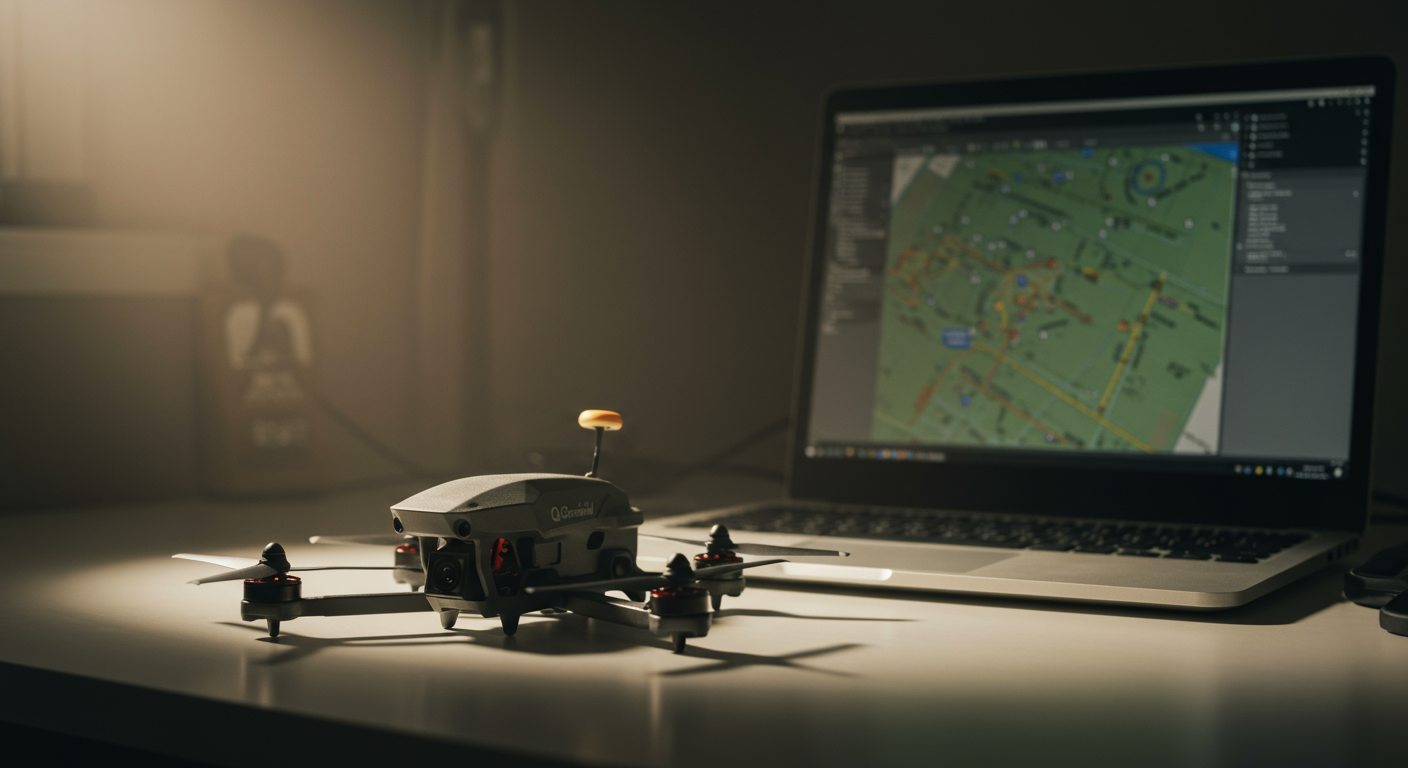
ArduPilot is the world's most capable open-source autopilot firmware, and it is the reason MemAero chose to build both the Aero 2 and Aero 3 around it rather than ship yet another Betaflight quad. An ArduPilot FPV drone gives you every feature you need to learn, compete, and create — Position Hold, waypoint missions, configurable Return-to-Home, deep PID tuning via QGroundControl — and crucially, none of those capabilities disappear because a manufacturer has discontinued a companion app or moved to a subscription model. When you buy a programmable drone running open firmware, you own it in the full sense: the hardware and the software.
What ArduPilot actually is
ArduPilot is a mature, community-developed autopilot project that runs on a wide range of flight controller hardware. It has been in active development since 2009, is used in everything from sub-250g racing builds to full-scale agricultural UAVs, and is maintained by hundreds of contributors under the ArduPilot Foundation. Unlike manufacturer-proprietary firmware — which ships on most off-the-shelf FPV drones and controls what features you can access — ArduPilot's source code is publicly auditable, forkable, and improvable. The ground control station, QGroundControl, is free, cross-platform, and actively developed. There is no paywall between you and your aircraft's full capability set.
What open firmware actually unlocks
The gap between a Betaflight quad and an ArduPilot quad is not just a list of flight modes — it is a different philosophy of what a drone is for. Betaflight is optimised for raw performance in Acro mode: fast PID loops, minimal latency, race-first tuning. ArduPilot adds a sensor fusion layer — GPS, barometer, compass, optical flow — that enables genuinely assisted flight. Position Hold uses GPS and barometer to hold a point in three-dimensional space hands-free. Return-to-Home autonomously recovers the aircraft to its launch point if signal is lost. Waypoint missions allow a pre-programmed flight path to be executed at the press of a button. These are not toys: they are the same systems used by professional survey and inspection operators. The MemAero Aero 2 ships with all of them enabled and accessible via the QGroundControl integration documented on the MemAero about page.
Open vs closed ecosystems: why it matters for ownership
Closed-firmware drones — the majority of consumer FPV products — have a hard ceiling: you can only do what the manufacturer permits in the companion app. When DJI removed features via a firmware update, users had no recourse. When a manufacturer discontinues a product line, the accompanying app may stop being maintained, and with it any features tied to server-side processing. ArduPilot has no such dependency. The firmware runs locally on the flight controller, the ground station runs locally on your phone or computer, and the community will continue developing both long after any individual manufacturer has moved on. For a UK pilot making a multi-hundred-pound investment in an FPV drone, this is not a minor detail — it is a direct measure of how long the drone will remain capable.
Repairable and programmable: the longevity argument
Repairability and programmability are two sides of the same coin. A drone that cannot be repaired forces you to replace the whole unit when a motor burns out or an arm cracks; a drone that cannot be reprogrammed forces you to replace it when your skills or mission requirements evolve. The MemAero Aero 2 is designed to fail gracefully: standard 5-inch motor mounts, accessible wiring looms, a slide-in rear battery that does not require disassembly to swap, and a parts supply chain maintained by MemAero in Lancaster. On the firmware side, any parameter tunable in ArduPilot — and there are hundreds — is tunable on the Aero 2. That means custom flight envelopes for training, specialist tuning for freestyle manoeuvres, or mission-specific configurations for survey work, all without touching the hardware.
ArduPilot for FPV freestyle and racing
A common misconception is that ArduPilot is too heavy — in processing terms — for FPV freestyle or racing, where latency and responsiveness are paramount. This was a legitimate concern five years ago; it is not today. Modern ArduPilot builds on F7 and H7 processors run fast enough for responsive freestyle flying, and the tuning tools available via ArduCopter's advanced configuration allow a pilot to tune the Aero 2 to a sharper feel than most factory Betaflight presets. The community has produced extensive tuning guides for 5-inch freestyle builds, and the MemAero Aero 2 ships with a tune that is immediately flyable while leaving full room for personalisation.
Who should choose an ArduPilot FPV drone
An ArduPilot FPV drone is the right choice for any pilot who wants to own their aircraft outright — its capabilities, its longevity, and its repairability. It is particularly well suited to beginners who want assisted flight modes while they learn; to intermediates who want to tune without switching platforms; and to creators and professionals who need waypoint missions or GPS-assisted stable shots. If you are new to the hobby, the MemAero UK drone law FAQ covers registration requirements before your first flight. If you are looking at the MemAero drone range, both the Aero 2 and Aero 3 run ArduPilot as standard — because we believe every FPV pilot deserves to own their drone, not just lease its features.
Frequently asked questions
What is ArduPilot and is it safe to use on an FPV drone?
ArduPilot is an open-source autopilot firmware used on millions of drones worldwide, from hobby builds to commercial inspection platforms. It is mature, actively maintained, and well-documented. When correctly configured it is safe for FPV use, and its assisted flight modes — Angle, Position Hold, Return-to-Home — make it arguably safer for beginners than raw Betaflight Acro mode.
What is the difference between ArduPilot and Betaflight?
Betaflight is optimised for raw performance in manual Acro mode with very low latency. ArduPilot adds a full sensor fusion layer — GPS, barometer, compass — enabling assisted flight modes such as Position Hold, waypoints, and Return-to-Home. Both are open-source; ArduPilot simply targets a broader mission scope beyond pure racing.
Do I need to know how to code to use ArduPilot?
No. All configuration is done through the QGroundControl GUI — a free desktop application for Windows, macOS, and Linux. You adjust parameters via sliders and dropdowns, review flight logs visually, and upload firmware updates with a single click. Coding knowledge is only needed if you want to contribute to the firmware itself.
Can I tune an ArduPilot drone for freestyle FPV?
Yes. Modern ArduPilot on a fast F7 or H7 processor is responsive enough for freestyle flying. The tuning process is different from Betaflight but equally powerful. MemAero ships the Aero 2 with a balanced factory tune; further tuning is possible through QGroundControl's parameter tree and the extensive ArduPilot community documentation.
What happens if ArduPilot is discontinued?
This is the strength of open-source: the firmware is publicly licensed. Even if the ArduPilot Foundation were to cease operations, the codebase would remain available on GitHub, and the community could continue developing it. Proprietary firmware from a commercial manufacturer carries far more discontinuation risk.
Does ArduPilot support DJI O4 video transmission?
Yes. The MemAero Aero 2 and Aero 3 combine ArduPilot on the flight controller with DJI O4 or DJI O4 Pro for the video link. The two systems are independent: ArduPilot handles flight control and navigation; DJI O4 handles the HD video stream and goggles connection. You get the best of both.