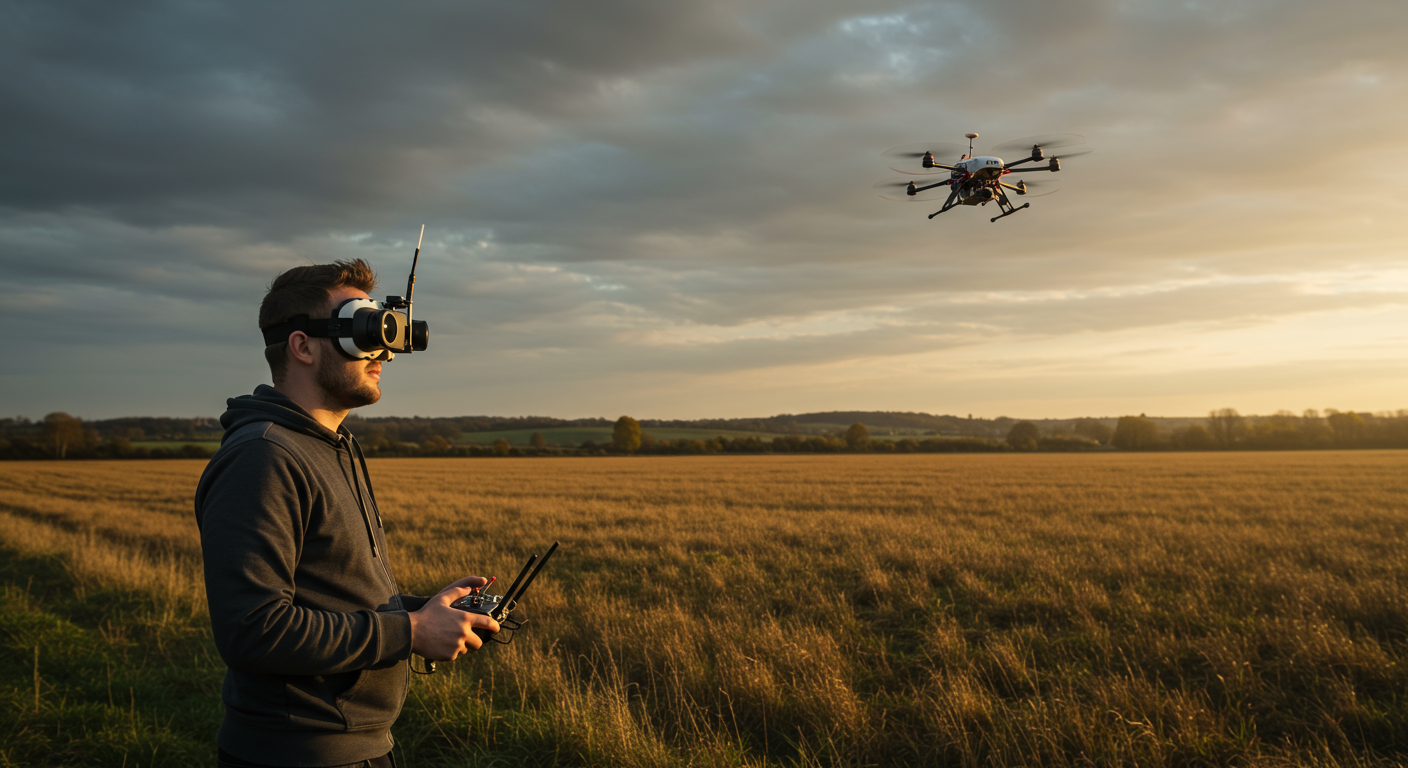
Yes, FPV drones are legal to fly in the UK for recreational use. To fly legally, every pilot aged 13 or over must hold a free CAA Flyer ID (obtained by passing an online theory test), and every drone over 100 g must be registered under a free CAA Operator ID. Both registrations are obtained through the CAA's online drone registration service and renewed annually for a small fee. The rules are set out in the UK Drone and Model Aircraft Code, which replaced the old Air Navigation Order framework.
Flyer ID and Operator ID — who needs what
Anyone flying a drone or model aircraft in the UK must understand the two separate registrations. The Flyer ID belongs to the person holding the controller — you take a free 40-question online theory test covering safety, privacy, and the UK rules. Pass (you need 75% or above) and your Flyer ID is issued instantly. The Operator ID covers the drone itself and is required for any unmanned aircraft over 100 g. The operator (usually the owner) registers once, pays a small annual fee (currently £10.33), and displays the Operator ID on every drone they own above the threshold. A 13-year-old can hold a Flyer ID in their own name; under-13s can fly under adult supervision as long as the supervising adult holds the Flyer ID and the drone is registered under an adult's Operator ID. There is no minimum age to be supervised. Both IDs are free to obtain initially via the CAA registration portal — only the annual renewal of the Operator ID carries a fee.
The 100 g registration threshold explained
The 100 g rule is the key weight threshold in UK drone law, and it catches many drones that people assume are exempt. Any drone weighing more than 100 g in take-off weight — including batteries and any attached payload — requires a registered Operator ID. This means almost every capable FPV drone is registerable. The MemAero Aero 2 (5-inch, approximately 450 g) and the Aero 3 (7-inch, approximately 720 g) both exceed this threshold and require registration. Only lightweight indoor foam aircraft or micro whoop-style drones under 100 g fly without operator registration, though their pilots still need a Flyer ID. The old 250 g boundary used in EU rules does not apply in Great Britain; the UK set its own 100 g threshold, which is significantly lower. Do not assume a drone is exempt because it is marketed as a toy or sold without mention of registration requirements.
Where you can and cannot fly FPV in the UK
The default position under the UK Drone Code is that you may fly at almost any open outdoor location below 120 m (400 ft) altitude, provided you remain in Visual Line of Sight (VLOS) — you must be able to see the drone with the naked eye at all times. FPV goggle flying is a nuance here: flying exclusively through goggles without a spotter who maintains unaided visual contact is considered Beyond Visual Line of Sight (BVLOS) and is not permitted for recreational pilots without a specific CAA exemption. Many FPV pilots comply by flying with a visual observer beside them who watches the aircraft throughout. You cannot fly within the Flight Restriction Zones (FRZs) around aerodromes, over crowds of people, or within restricted airspace without permission. The NATS drone flying page and the free NATS Drone Assist app show FRZs and notified areas on a map before you fly. National parks and Sites of Special Scientific Interest have additional local bylaws worth checking in advance.
FPV drone rules for commercial use — the GVC
If you want to fly commercially — meaning you receive any payment for the flight, the footage, or a service connected to the flight — the rules escalate. You will need the General Visual Line of Sight Certificate (GVC), a CAA-recognised qualification covering ground school theory and practical assessment. The GVC is delivered by approved National Qualified Entities (NQEs) and typically costs between £800 and £1,500 depending on the provider, including the theory course, practical test, and CAA approval fees. Commercial FPV work also requires you to hold appropriate liability insurance. The recreational registrations (Flyer ID + Operator ID) cover only non-commercial personal flying. Note that creating YouTube content or social media content is generally treated as commercial activity by most insurance providers and arguably by the CAA, so pilots monetising their flying should take professional advice and consider obtaining the GVC.
Age rules and flying as a teenager
The minimum age to hold a Flyer ID in your own name is 13. Below that age, a child may fly a drone under the active supervision of an adult Flyer ID holder, but the adult must be physically present and watching the aircraft. The Operator ID for the drone must be registered by an adult (18+) if the child is under 13. Once a young person reaches 13, they can sit the theory test independently and hold their own Flyer ID, though the drone still needs to be registered — whoever owns it registers as Operator. This makes FPV genuinely accessible to capable teenagers with parental involvement. There is no upper age limit, no medical requirement, and no practical test needed for recreational flying. The MemAero FAQ page covers common questions about age, registration, and flying safely as a newcomer to FPV.
What the 2026 rule changes mean for FPV pilots
The CAA announced significant changes to UK drone rules taking effect in 2026, including the phased introduction of Remote ID requirements for drones above 250 g. Remote ID broadcasts your drone's position, altitude, and operator reference in real time via a wireless signal that receivers can pick up nearby — similar in concept to ADS-B for aircraft. For most recreational FPV pilots flying existing equipment, the immediate practical impact is limited: the rollout focuses on new drones entering the market, and the CAA has indicated a transition period. The Flyer ID and Operator ID system remains unchanged. The new UK drone class marks (UK C0 through UK C6) will replace the old CE/UKCA categories on new drones sold after a transition date. Pilots flying existing unclassed drones under the old transitional provisions can continue to do so under the legacy rules for a defined period. Staying informed via the CAA website is the only reliable way to track these changes, as the detail evolves quickly.
This video from February 2026 gives a clear, up-to-date walkthrough of the UK Drone Code as it stands:
If you are considering your first proper FPV drone and want to understand the registration process before you buy, our guide to getting started in FPV in the UK walks through the whole beginner path from simulator to first outdoor flight.
Frequently asked questions
Is FPV drone flying legal in the UK?
Yes. FPV drones are legal to fly recreationally in the UK. The pilot needs a free CAA Flyer ID, and any drone over 100 g needs to be registered under a CAA Operator ID. Flying through goggles without a spotter who has direct unaided visual contact is technically BVLOS and requires a specific exemption, which is why most compliant FPV pilots fly with a visual observer.
Do I need a licence to fly an FPV drone in the UK?
There is no formal pilot licence for recreational FPV flying. You need a free Flyer ID, which requires passing a 40-question online theory test on the CAA website. Commercial pilots need the GVC qualification. The Flyer ID is not a licence in the traditional sense — it is a competency registration that proves you have read and understood the rules.
What is the weight threshold for drone registration in the UK?
Any drone weighing more than 100 g must be registered under a CAA Operator ID. This is lower than the 250 g EU threshold and catches the vast majority of capable FPV drones. The Operator ID costs £10.33 per year to maintain and must be displayed on the aircraft.
Can a 13-year-old fly an FPV drone legally in the UK?
Yes. From age 13, a young person can sit the Flyer ID theory test and hold their own CAA Flyer ID. Under 13, flying is permitted under the active supervision of a qualified adult. In both cases the drone itself must be registered under an Operator ID held by an adult (18+) if the child is under 13 and does not own the drone outright.
Can I fly FPV drones in UK national parks?
Recreational drone flying below 120 m is generally permitted in national parks unless specific bylaws or site management rules say otherwise. Some sensitive areas within national parks have local restrictions. Always check before you fly — many nature reserves and Sites of Special Scientific Interest have their own rules that go beyond the national drone code.
What is the CAA Flyer ID test like?
The CAA Flyer ID theory test is a 40-question multiple-choice online test taken at home for free. It covers the UK drone rules, safety practices, airspace, and privacy law. You need 75% or above to pass. There is no time limit and you can retake it if you fail. Most people pass first time after reading the guidance notes provided alongside the test.
Do I need insurance to fly an FPV drone in the UK?
Third-party liability insurance is not legally required for recreational pilots, but it is strongly recommended. Many drone clubs include cover in their membership, and standalone annual policies are available for under £50. If you fly commercially — or create content you monetise — liability insurance is essentially mandatory and your Operator ID alone is not sufficient.