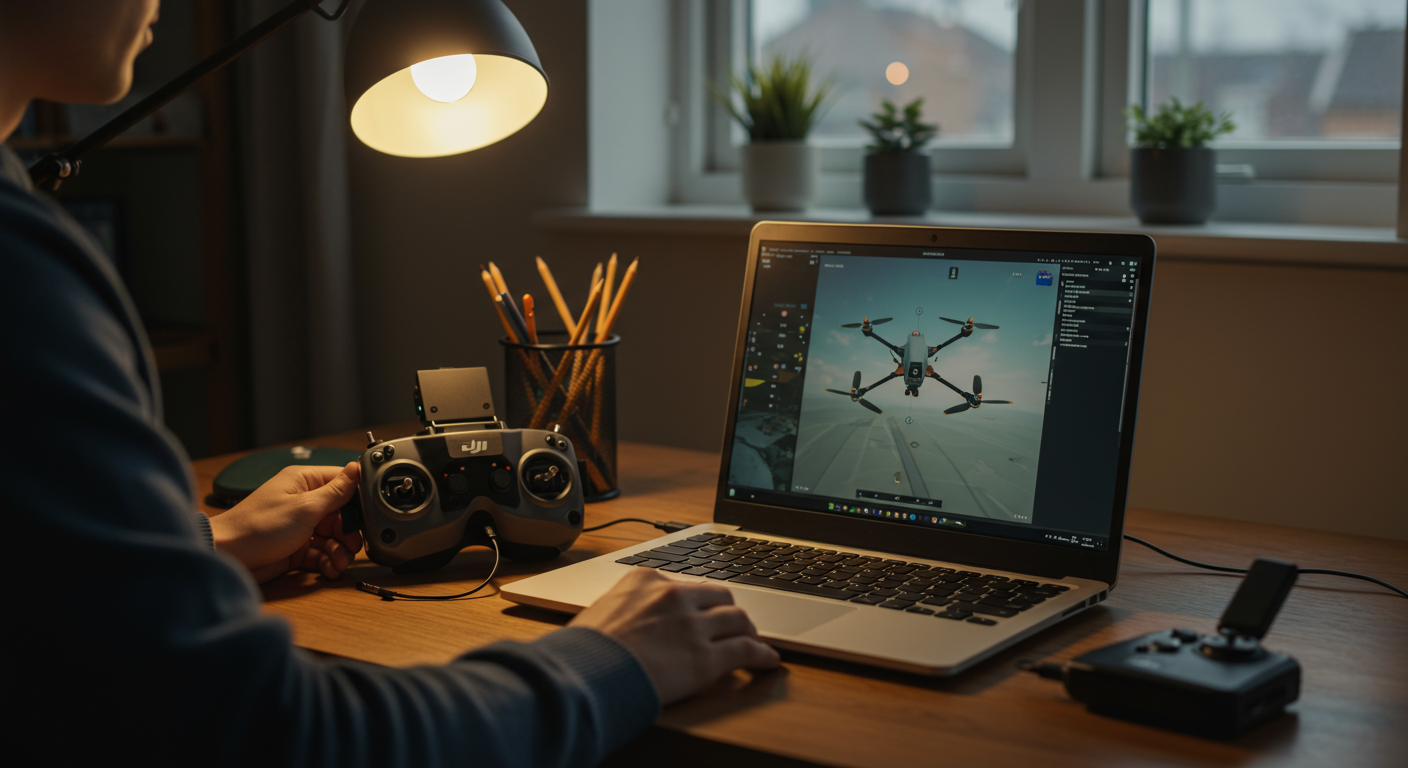
Getting started in FPV in the UK takes three things: a simulator, a radio controller, and time. Every experienced FPV pilot will tell you the same thing — skip the sim and you will crash your first real drone within 30 seconds. The honest beginner path is: spend one to four weeks flying exclusively on a simulator such as Liftoff or Velocidrone, get comfortable with full manual or acro mode, then buy your first real aircraft. Once you have a drone that weighs over 100 g (which covers almost every capable FPV drone), you register for a free CAA Operator ID and sit the free CAA Flyer ID theory test. Then you find a suitable open site and fly — under visual observation from day one.
Step one — the simulator is not optional
The most common beginner mistake in FPV is buying a real drone before developing any stick skills. An FPV drone flying in full acro mode has no self-levelling, no GPS hold, and no hesitation — it does exactly what the sticks command, including flying straight into the ground. Simulators remove the financial and emotional cost of that learning curve entirely. Liftoff (available on Steam for around £18) and Velocidrone (£15) are the two most used platforms in the UK FPV community. Both allow you to fly a realistic physics model of a 5-inch freestyle drone with your own radio controller connected via USB. Spend the first week just learning to hover and maintain orientation. In week two, start flying circuits. By week three or four, you should be comfortable recovering from unusual attitudes — that is when you are ready to move to a real drone. Flying 20 hours on a simulator is worth more than crashing 10 real drones.
The gear you actually need (and what to skip)
A minimal FPV setup requires three things: a radio controller, FPV goggles, and a drone. Everything else is optional at the start. For the radio, a mid-range controller with ELRS or Crossfire protocol support costs £40–100 and connects to your simulator via USB while you learn. Do not buy the cheapest possible controller — you will likely keep it for years. For goggles, the digital vs analogue decision is significant: digital systems (DJI O4, Walksnail Avatar) give a sharp, low-latency image that makes orientation much easier for beginners, at a higher cost. Analogue goggles (£30–60) are cheaper but the image quality is noticeably inferior. For your first real drone, a 3-inch or 5-inch ready-to-fly (RTF) system removes the complexity of building. The MemAero Aero 2 is a 5-inch RTF drone with DJI O4 video and ELRS radio — it arrives ready to bind to your controller and fly, without the soldering and configuration that a self-build requires. Accessories to add from day one: a battery charger, at least two batteries, and a full set of spare props for your chosen frame size — see the MemAero accessories page for compatible props and batteries.
Ready-to-fly vs building your own drone
Every FPV forum has this debate and the honest answer is: start RTF, build later. Building an FPV drone from scratch — choosing a frame, sourcing motors, ESCs, a flight controller, a video transmitter, and soldering it all together — is a genuinely rewarding process once you understand what each component does. But attempting it as a complete beginner means you are learning electronics, soldering, firmware configuration, and flying all at once. The failure mode is spending six weeks building, finding a problem you cannot diagnose, and never actually flying. A ready-to-fly drone gets you in the air in an afternoon. Once you have flown 10 hours and crashed a few times, you will understand the components from direct experience, and a build will make much more sense. Many pilots build their second or third aircraft. The MemAero drone range is designed for pilots who want to fly on day one but own and understand their aircraft — open ArduPilot firmware means you are never locked out of the configuration, even with an RTF purchase.
UK registration before your first outdoor flight
Before flying any drone over 100 g outdoors in the UK, you need two free registrations from the CAA drone registration portal. The Flyer ID is a personal registration — you pass a 40-question online theory test (free, no time limit, retakeable) covering UK drone law, airspace, and safety. The Operator ID covers the aircraft and costs £10.33 per year to maintain after the first free registration. You display your Operator ID on the drone — a small printed label on the frame. Registration takes about 30 minutes for both, including reading the guidance. Almost every capable FPV drone — including a 5-inch freestyle quad weighing around 450 g — exceeds the 100 g threshold, so this step is not optional. The process is straightforward and the theory test is not designed to catch people out; it is designed to make sure you have actually read the UK rules. Our full explainer on UK FPV drone legality covers registration and the rules in depth.
Where to fly your first real FPV flights
Your first outdoor flights should be somewhere flat, open, and away from people, trees, and power lines. A sports field, a flat park (when empty), or agricultural land with the landowner's permission are all good options. The NATS Drone Assist app (free on iOS and Android) shows Flight Restriction Zones and notified areas on a map — always check it before a new site. Stay below 120 m altitude and remain within Visual Line of Sight. For FPV goggle flying, the simplest legal approach is to have a second person beside you who watches the drone throughout — they act as your visual observer while you fly through the goggles. UK FPV clubs (affiliated with the BMFA) often have access to designated flying sites with established safety protocols, and flying alongside experienced club members is the fastest way to improve after the simulator.
This 2025 video compares the two leading FPV simulators for beginners — a useful watch before you commit to one:
Your first 10 hours — what to expect
Hour one on a real drone will feel very different from the simulator, even with solid sim time. The audio, vibration feedback, and wind response are all new inputs your brain needs to process. Expect the first few minutes to feel slightly disorienting, especially orientation at distance. Start in a stabilised or angle mode (self-levelling) for the first session even if you plan to fly acro long-term — it builds spatial confidence without the recovery demands of full manual. Progress to Acro mode once orientation clicks. Your first ten hours of real flying should involve a lot of slow, deliberate manoeuvres: hovering, slow circuits, gentle turns, controlled descents. Speed comes naturally after control. Crashes are normal and expected — that is why you buy spare props. The MemAero waitlist is the best way to stay updated on UK-made FPV drones built for exactly this progression path — from first flight through to confident sport flying. See also our guide to the best drone for a teenager in the UK if you are buying for a young pilot.
Frequently asked questions
How long does it take to learn FPV?
Most pilots reach a competent recreational level — comfortable in acro mode, flying circuits confidently, recovering from common situations — within 20 to 40 hours of total flying time, including simulator hours. The simulator hours count: pilots who put in 15+ hours on a sim before their first real flight progress significantly faster than those who go straight to a real drone.
What FPV simulator should a beginner use in the UK?
Liftoff and Velocidrone are both strong choices. Liftoff has a more accessible interface and good course variety; Velocidrone has more physics options and is popular with competitive racers. Both cost around £15–18 on Steam and support most common radio controllers via USB. Either will serve a beginner well — the specific simulator matters far less than the hours you put in.
Do I need a radio controller for FPV?
Yes. An FPV drone is controlled by a dedicated radio controller transmitting on 2.4 GHz (with protocols like ELRS or Crossfire), not by a smartphone app. A decent starter controller costs £40–100 and doubles as your simulator controller via USB. Buying the same controller for sim and real flying means your muscle memory transfers directly.
What is the difference between FPV and a regular drone?
A regular consumer drone (like a DJI Mini) flies itself — GPS hold, obstacle avoidance, and an app handle most of the work. An FPV drone is flown manually via a controller, with the pilot seeing a real-time video feed through goggles. FPV flying is more demanding, more physical, and more rewarding for people who enjoy the act of flying rather than just the footage.
Do I need to register before flying FPV in the UK?
Yes. Any drone over 100 g requires a CAA Operator ID (the owner registers the aircraft, annual fee £10.33). Every pilot aged 13 or over needs a CAA Flyer ID (free theory test). Both are obtained via the CAA's online portal. Flying outdoors without these registrations is illegal and can result in a fine.
Is FPV safe for beginners?
FPV is as safe as the pilot makes it. The key safety practices are: fly in open areas away from people and property, use a simulator to build skills before flying a real drone, fly within visual line of sight, and have a visual observer alongside for goggle flying. Crashes are a normal part of learning — that is why props are cheap and frames are repairable.
What is ready-to-fly (RTF) FPV?
A ready-to-fly (RTF) FPV drone arrives fully assembled and configured, needing only a bind to your radio controller before the first flight. RTF removes the soldering and firmware configuration of a self-build, making it the practical choice for beginners. The MemAero Aero 2 is an RTF 5-inch FPV drone designed to fly on day one while remaining fully open and repairable.