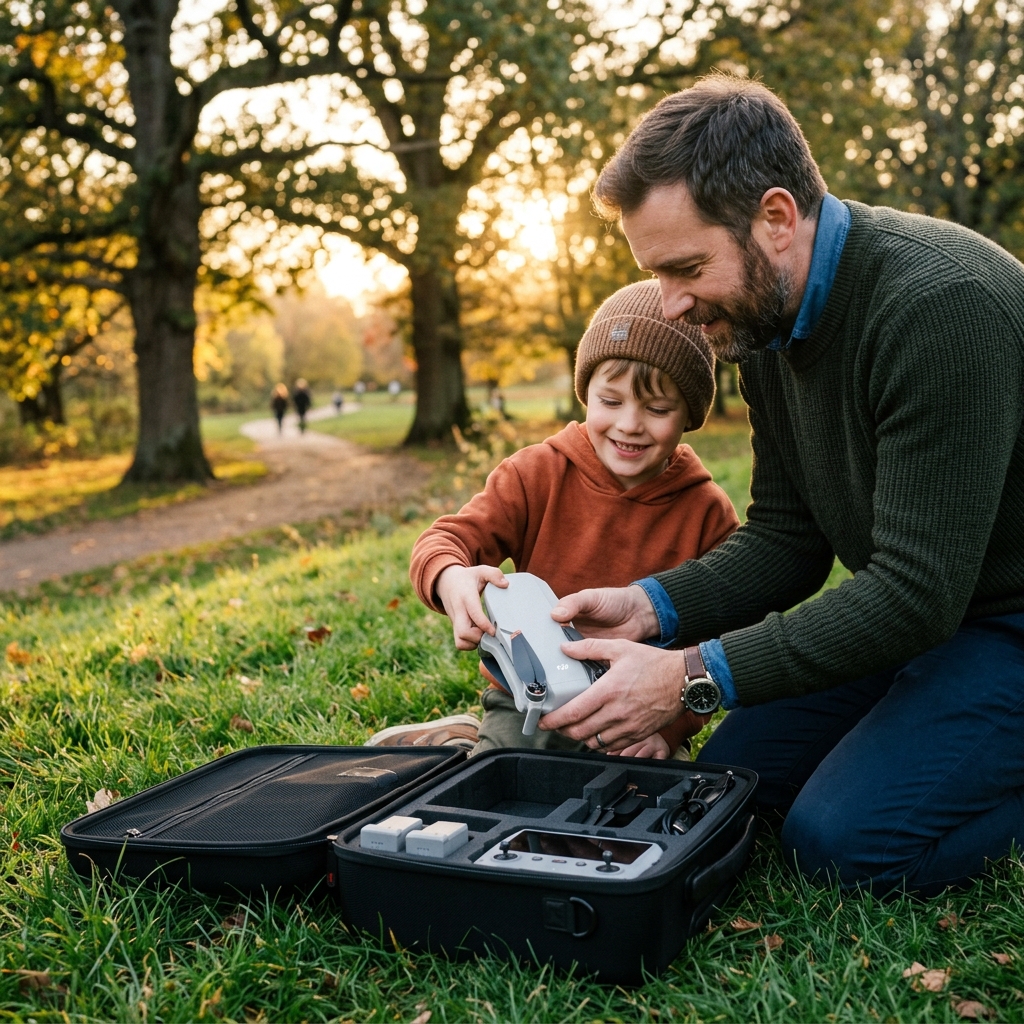
The sub-£100 drone market in the UK gives families a genuine entry point into aerial flying. At this price point you are buying a toy-grade or entry-level consumer drone — not a professional tool — and understanding that honestly is the key to a good first purchase. This guide covers what to look for, what the CAA rules actually say, and how to get the most from a budget drone before deciding whether you want to go further into the hobby.
What to Expect from a Budget Drone Under £100
Between £50 and £100 you will find drones with brushless motors, basic GPS stabilisation, and cameras capable of 720p to 1080p video — a meaningful step up from the toy-grade models at the very bottom of the market. GPS position hold is the feature that makes the biggest practical difference for beginners: the drone stays where you leave it in the air, so you can focus on flying rather than fighting the wind.
App connectivity is now standard in this bracket. Viewing live footage on a smartphone makes flights far more engaging, particularly for children watching from the ground. Spare propellers bundled in the box are a small but telling sign of a quality product — propeller damage is the most common beginner incident, and having spares avoids ending a session early.
What this price point does not buy: cinema-quality footage, long range, meaningful wind resistance, or a drone that will survive a hard landing cleanly. Be realistic about that and the experience is a good one.
CAA Rules for Sub-£100 Drones in the UK
UK Civil Aviation Authority rules apply to all drones regardless of price. Drones weighing under 100g require no CAA registration and no Flyer ID for recreational use — a category that covers many of the lightest toy-grade models. Drones over 100g require a free CAA Operator ID and Flyer ID before flying — both are completed online and take around 20 minutes in total.
Regardless of weight, all pilots must: maintain visual line of sight at all times, stay below 120 metres altitude, stay clear of airports and restricted airspace, and not film individuals without consent. The CAA's Drone Code is a concise summary worth reading before your first flight. The NATS Drone Assist app (free) confirms whether a location is clear to fly before you head out.
Responsible flying protects this low-regulation category for everyone — particularly important as drone popularity grows in parks and coastal areas.
What to Look for in a Family Budget Drone
Brushless motors are the most important component upgrade to look for. They are quieter, smoother, and significantly more durable than the brushed motors common in the cheapest models. GPS altitude hold keeps the drone stable without constant input corrections — essential when children are watching and the pilot is distracted. Propeller guards are a meaningful safety feature, not a gimmick, in any environment where people are nearby.
UK-specific consideration: choose a supplier with genuine UK customer support. When something goes wrong — and with entry-level drones, something usually does — being able to contact someone directly and get replacement parts matters. Marketplace imports often have no UK support at all.
Best Practice for Family Drone Sessions
Open flat ground with good visibility and minimal foot traffic is the right environment to start. Early morning sessions in local parks offer calmer wind, better light for cameras, and fewer people to navigate around. Always do a pre-flight check: propellers secure and undamaged, battery charged, controller paired.
Fly conservatively for the first few sessions. Hover at head height to test controls before climbing higher. Budget drones in this category are not designed for aggressive manoeuvres, and most crashes happen when pilots push limits before understanding the drone's handling. Download a drone airspace checker before flying anywhere new — it takes 30 seconds and confirms you are not in a restricted zone.
Battery Care and Maintenance
Battery care is the single biggest factor in how long a budget drone's components last. Never fully drain lithium batteries, and do not leave them fully charged for extended periods. If storing for more than a week, discharge to around 50–60% charge first. After every session, inspect propellers for chips or cracks and replace any that look damaged — these are consumable items at this price point. Store the drone in a padded bag: the camera mount is often the most fragile component and worth protecting.
Comparing Budget Drone Brands in the UK
The UK market mixes established brands with unbranded imports. Established brands provide enforceable warranties, replacement parts, and UK support — all practically important when something goes wrong. Unbranded marketplace imports can be tempting at £20–£35, but component failure rates are higher and replacement parts are often unavailable. For a family investment, a reputable brand in the £60–£100 range is consistently better value than repeatedly replacing a £30 model.
DJI's Mini series sits at the higher end of or above this bracket but sets the benchmark for GPS performance. Ryze Tech's Tello is a popular indoor/casual option. Read verified UK buyer reviews specifically — UK weather and CAA context creates different real-world use cases than global platform reviews reflect.
When You're Ready to Go Further: the FPV Step-Up
Budget family drones are a fine starting point, but a significant number of people who start here want more within 6–12 months: more control, more capability, more real flying. That is when FPV (first-person view) flying becomes relevant.
FPV is a fundamentally different experience from GPS-assisted toy drones — you fly from the drone's perspective through a headset, with full manual control and much greater range and agility. It requires more learning, but the capability ceiling is orders of magnitude higher.
MemAero is a Lancaster-based manufacturer making UK-designed FPV drones. We no longer make the sub-250g budget Aero 1 Lite — MemAero now focuses on proper, ownable FPV. The Aero 2 is a 5-inch freestyle FPV drone designed to be a genuine first FPV machine: beginner-friendly firmware via ArduPilot, DJI O4 video, a shared smart battery, and fully repairable. The Aero 3 is a 7-inch long-range FPV drone aimed at creators and explorers. Neither is a £100 toy — they are serious tools for pilots who know what they want from the hobby.
If you are buying a budget drone now and wondering what comes next, our guide to the best FPV drones for beginners in the UK is the honest answer to that question.
MemAero has moved to UK-made FPV
The Aero 2 and Aero 3 are designed and built in Lancaster — programmable, repairable, and ownable. Founders pricing and a free spare battery for waitlist members.
Join the waitlist →Summary
For families entering drone flying, the £60–£100 bracket is the right starting point: GPS stabilisation, brushless motors, and a proper warranty without requiring CAA registration for most models. These drones do what they say and are a good way to discover whether flying is a hobby worth pursuing seriously. When you are ready for the step up to real FPV flying, explore what MemAero is building in Lancaster.
Do I need to register a budget drone under £100 in the UK?
It depends on weight. Drones under 100g require no registration for recreational use. Any drone over 100g must be registered with a free CAA Operator ID and Flyer ID, both completed online. Always verify the actual weight of the model you are buying — some are marketed as lightweight but come in above these thresholds.
How long do budget drone batteries last?
Most budget drones offer 10–18 minutes per charge. Buying extra batteries is strongly recommended for family sessions — recharge time often exceeds flight time with a single battery.
Are budget drones safe for children to use?
Yes, when supervised and flown in appropriate open areas. Choose models with propeller guards, altitude hold, and headless mode for the safest beginner experience. Younger children should fly with an adult actively managing the controller.
What comes after a budget family drone?
Many pilots who start with a budget GPS drone move on to FPV flying — a fundamentally different experience with far greater capability. Our guide to the best FPV drones for beginners in the UK covers the step-up in full.