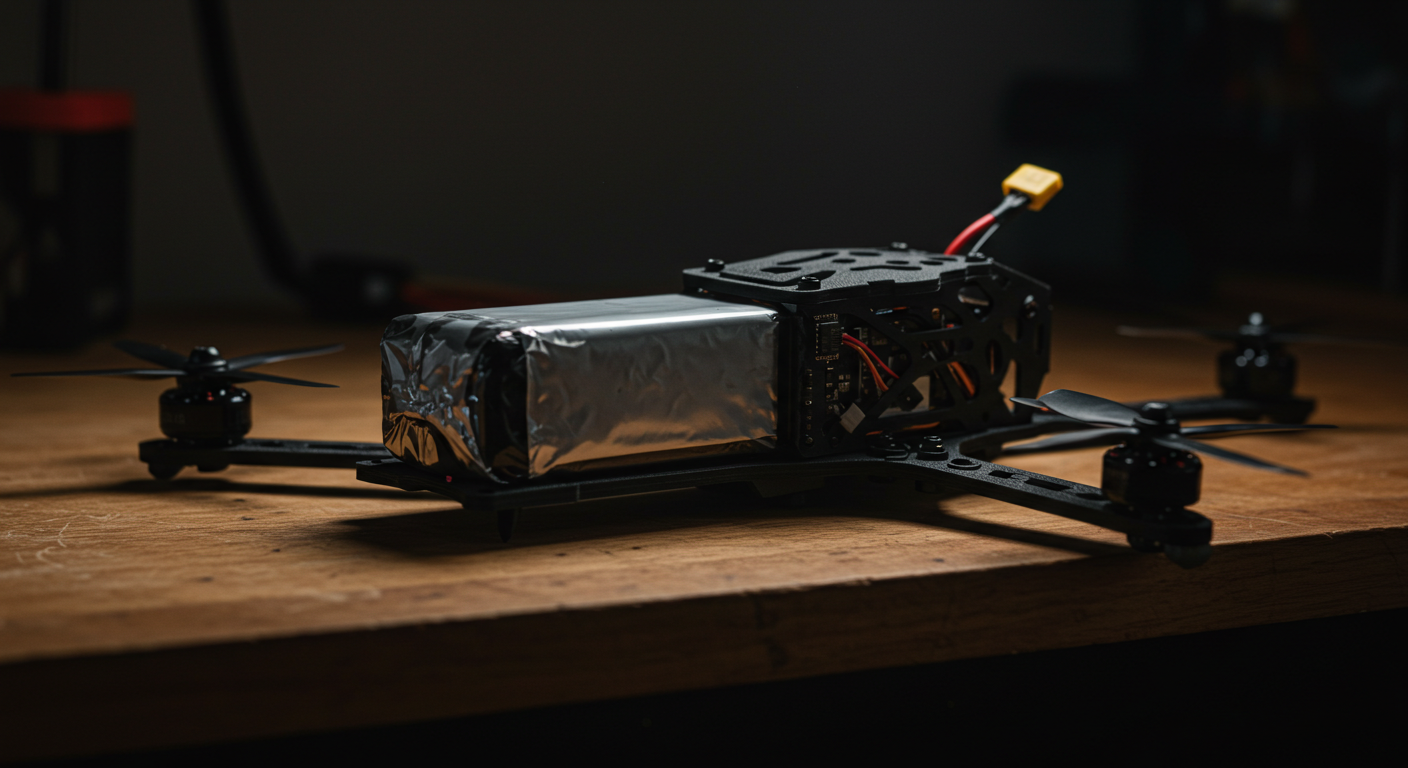
A smart FPV drone battery is a sealed, integrated power pack that slides directly into a dedicated bay in the airframe — no straps, no exposed connectors, no guesswork about positioning. Unlike a traditional bare LiPo that you tape or velcro to the top of a drone frame, a smart battery includes on-board circuitry that monitors cell voltage, cycle count, temperature, and state of charge. The result is safer handling, more consistent flight performance, and a charging experience closer to a laptop battery than a hobby-grade consumable. Both MemAero models — the Aero 2 and the Aero 3 — use the same sealed slide-in smart battery, which means one spare covers both aircraft.
What makes a battery "smart"?
A smart battery adds a microcontroller and a battery management system (BMS) to what would otherwise be a raw lithium cell stack. The BMS reads voltage at individual cell level, not just pack level, and can communicate state-of-charge data to the charger and to the flight controller. In practical terms this means: the charger knows when the pack is full without you counting cell voltages; the drone knows how much flight time remains rather than guessing from a single voltage reading; and the pack can refuse to charge if a cell is outside safe parameters. Smart batteries used in consumer FPV drones — DJI popularised the form with the Avata range — typically use a keyed plastic housing that locks into a rear bay, so the pack cannot shift in flight or be inserted backwards. The BMS also logs cycle counts, useful when assessing a second-hand battery: 200 cycles warrants more scrutiny than 20.
Smart battery versus a bare LiPo on a strap
The traditional FPV approach uses a raw lithium polymer (LiPo) pack with exposed XT30 or XT60 connectors and a balance lead. The pilot tapes or velcro-straps the pack somewhere on the frame — usually the top spine — and plugs in the power lead before every flight. This works, and it is why most racing and freestyle quads still fly this way: raw LiPos are cheap, swappable in seconds, and available in hundreds of cell and capacity combinations. The downsides are real: the strap can fail, the pack can shift mid-flight and upset the centre of gravity, balance leads are fragile, and a crash can puncture an unhoused cell. A sealed smart battery removes all of those failure modes. The trade-off is lock-in — you cannot grab any 4S 1300 mAh pack from your collection. For a pilot who owns one or two aircraft and values consistency over tunability, that is an acceptable bargain.
LiPo basics: what the numbers mean
Whether sealed or bare, the cells inside every FPV drone battery are lithium polymer chemistry. Understanding the key figures helps you charge and store the pack correctly. Cell count is written as "4S" or "6S" — S stands for series, meaning four or six cells wired in series. Each LiPo cell has a nominal voltage of 3.7 V, so a 4S pack sits at around 14.8 V nominal and charges to 16.8 V at full. Capacity is measured in milliamp-hours (mAh): a 2000 mAh pack can theoretically supply 2000 mA for one hour. C-rating expresses maximum continuous discharge as a multiple of capacity — a 100C 2000 mAh pack can deliver 200 A briefly, though stated C-ratings are often optimistic marketing figures. In a sealed smart battery these numbers are managed for you: the BMS enforces safe discharge limits so you cannot pull the cells below the minimum safe voltage even if the motors demand it.
Safe charging, storage, and care
LiPo cells are stable when handled correctly and hazardous when not. The rules apply whether your pack is sealed or bare. Charge at 1C (one times the capacity in amps) unless the BMS explicitly permits more. Never leave a LiPo at full charge for more than a day or two — a fully charged cell degrades faster than one held at storage voltage (approximately 3.8 V per cell); most smart chargers have a storage mode for this. Store in a cool, dry place away from flammable material in a LiPo-safe bag or metal ammunition box. A pack that becomes puffy after a normal charge should be retired and disposed of at a battery recycling point. The Wikipedia article on lithium polymer batteries covers the underlying chemistry in plain language. For UK operating rules, the CAA Drone Code overview is the definitive source.
Why one battery fits both MemAero drones
MemAero engineered the Aero 2 and Aero 3 around a single shared battery format to reduce the overhead of owning two aircraft: one type of spare, one charger setting, one storage bag. The battery slides in from the rear and clicks into a latched bay. Because both drones run open ArduPilot firmware, the flight controller reads the BMS data directly — state of charge, cell voltages, and pack temperature appear in the QGroundControl app on your phone. When the pack reaches the low-voltage threshold you set, the drone initiates Return-to-Home. UK pilots registering both aircraft under a free CAA Operator ID (both models exceed the 100 g threshold) have one less variable to track. An Aero spare battery lets you extend a session without waiting for a recharge.
This video gives a clear comparison of real-world FPV LiPo quality and what to look for when evaluating a battery:
Frequently asked questions
What is a smart FPV drone battery?
A smart FPV drone battery is a sealed, integrated power pack with on-board electronics — a battery management system — that monitors cell voltage, temperature, and cycle count. It communicates this data to the charger and to the drone's flight controller, enabling safer charging, more accurate remaining flight-time estimates, and automatic low-voltage protection. The MemAero Aero 2 and Aero 3 both use this sealed slide-in format.
What is the difference between a smart battery and a regular LiPo?
A regular LiPo is a raw cell stack with exposed connectors and a balance lead; the pilot is responsible for all monitoring and handling. A smart battery adds a microcontroller and BMS that manage charging limits, log cycle counts, and can prevent over-discharge. The trade-off is that smart batteries are aircraft-specific rather than universal, but they are simpler and safer for pilots who do not want to manage multiple raw pack configurations.
How do I charge a smart FPV drone battery safely?
Use the manufacturer's recommended charger and charge at no more than the stated rate — typically 1C (one times the mAh capacity in amps). Do not leave a fully charged pack sitting for more than a day or two; put it into storage mode at around 3.8 V per cell if you are not flying soon. Always charge in a cool, open space away from flammable material, and never leave a charging LiPo unattended for long periods.
How should I store a LiPo battery when not in use?
Store at approximately 3.8 V per cell — this is the storage voltage that minimises calendar degradation. A good smart charger will have a dedicated storage mode. Keep packs in a cool, dry location; a LiPo-safe bag or a metal ammunition box reduces fire risk if a cell vents. Do not store at full charge (4.2 V per cell) for extended periods, as this accelerates capacity loss.
Do both MemAero drones use the same battery?
Yes. The Aero 2 (5-inch, approximately 450 g) and the Aero 3 (7-inch, approximately 720 g) share the same sealed slide-in battery format. This means one spare battery and one charging setup covers both aircraft, which simplifies kit management when flying or travelling with both drones.
Does the MemAero battery need to be registered with the CAA?
The battery itself does not require separate registration, but both MemAero aircraft weigh well above the UK's 100 g registration threshold, so each drone must be registered under a CAA Operator ID. Registration is free and straightforward via the CAA drone registration portal. The pilot also needs a free CAA Flyer ID obtained by passing a short online theory test.
What happens when the battery runs low during a flight?
Because both MemAero drones run ArduPilot firmware, the flight controller reads the battery BMS data in real time. When the pack reaches the low-voltage failsafe threshold you configure in QGroundControl, the drone initiates an automatic Return-to-Home sequence rather than simply cutting power. You can adjust the threshold and failsafe behaviour through the app before flying.