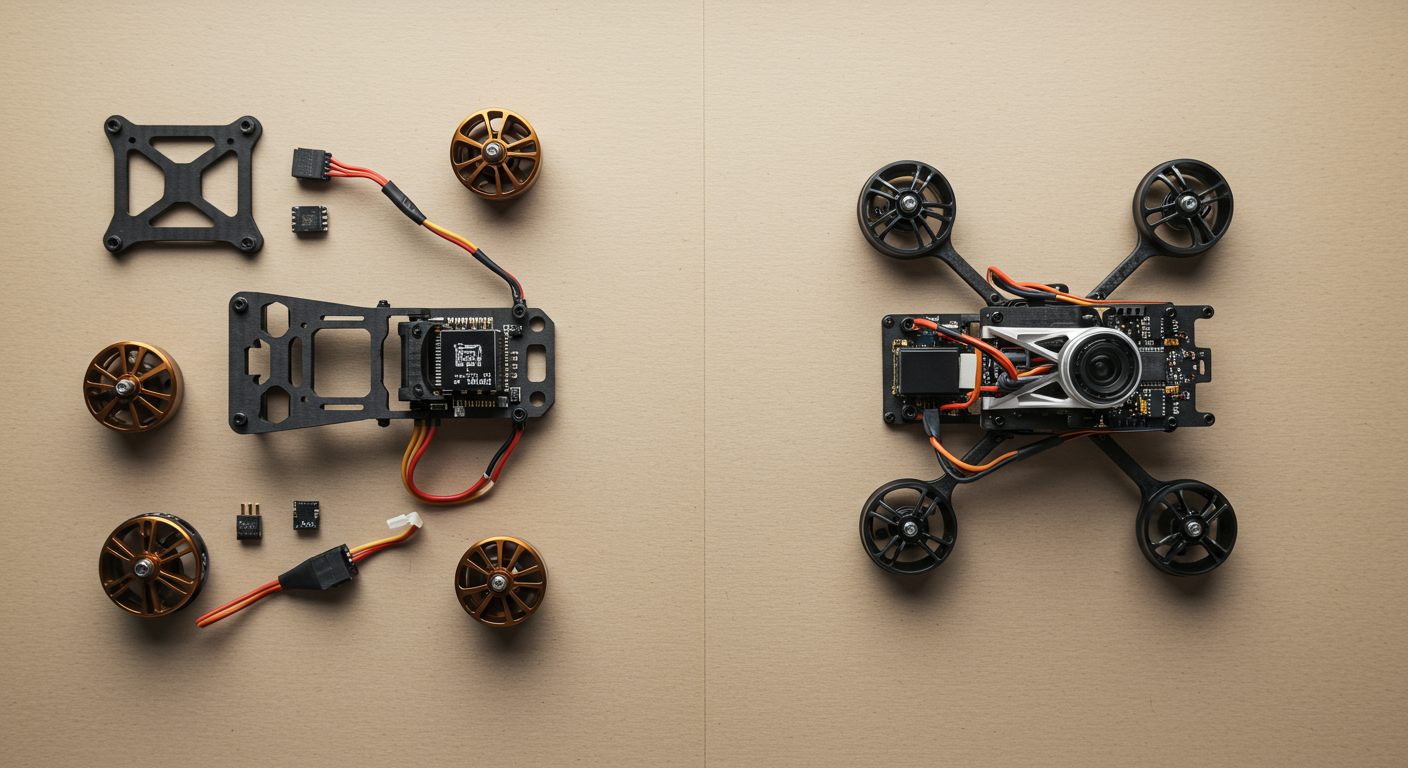
The honest answer to the build vs buy FPV drone debate in 2026 is: building teaches you more and costs less up front on components, but takes 20–40 hours of learning, sourcing, soldering, and tuning before your first flight. Buying a ready-to-fly (RTF) FPV drone means flying within a day but costs more at launch. For most beginners, the better question is not which is cheaper, but which type of first experience keeps you flying a year later.
The real cost of building your own FPV drone
A DIY FPV drone build is not simply cheaper than an RTF. The component cost of a quality 5-inch freestyle build — frame, flight controller, ESC stack, motors, propellers, receiver, video system, and camera — typically comes to between £200 and £350 depending on choices. You will also need a soldering iron, flux, heat-shrink, tools, and consumables if you do not already own them, which adds £50–£100 for a decent setup. Mistakes during soldering — and there will be some — cost replacement parts. Then there is time: a first build realistically takes a full weekend for someone following tutorial videos carefully, plus several hours of Betaflight configuration and motor testing before a maiden flight is safe. If your first build flies badly, diagnosing whether the problem is the tune, a wiring error, or a damaged ESC requires knowledge you may not yet have. None of this is insurmountable — but it is the honest picture, not just the component price comparison.
What building teaches you — and why that matters
The genuine advantage of building is understanding. When you have soldered every component, configured the flight controller from scratch, and set your own motor direction and PID values, you understand your aircraft in a way that no RTF pilot does. This pays forward immediately: when you crash (and you will crash), you can diagnose and repair the damage yourself because you know how each part is connected. You also develop an intuition for flight characteristics because you tuned them. Builders tend to be more confident in the air faster, even if the first-flight experience is slower to arrive. For anyone who enjoys electronics, tinkering, and problem-solving as part of the hobby, building is the more rewarding path. The ArduPilot community and resources like the RCGroups FPV forum are extensive — most build problems have been documented and solved by someone before you.
When buying ready-to-fly makes more sense
Ready-to-fly is the better starting point when you want to spend your time flying, not building. An RTF quad ships with motors tuned and balanced, a receiver pre-soldered, and a flight controller configured well enough to fly safely on day one. The time-to-first-flight is measured in hours, not weeks. RTF is also the right call if soldering is genuinely beyond your current skill set — a poorly soldered joint on an ESC is a fire risk and a flight risk, and not every beginner wants to acquire that skill before flying. RTF does not mean you give up ownership: a well-chosen RTF that runs open firmware and uses standard components is fully repairable once you understand it, even if you did not build it yourself. The key is choosing an RTF platform that does not lock you in — one where you can access the firmware, buy replacement parts individually, and repair rather than replace.
The soldering reality — and how to decide
Soldering is the skill that most determines whether a self-build is a good use of your time. A clean solder joint on an XT60 connector or an ESC pad takes practice. Bad joints cause intermittent problems that are difficult to diagnose in flight and can cause ESC failure or, in rare cases, battery fires. Before committing to a full build, it is worth spending an evening practising on cheap wire and connector offcuts — there are excellent tutorials on the build vs buy decision and on soldering technique specifically. If you find soldering satisfying, build. If you find it frustrating after an honest trial, buy a quality RTF and learn the aircraft once it is in your hands. There is no wrong answer here — both paths produce pilots who fly well eventually.
RTF but still open: MemAero's position
The conventional framing is that RTF means surrendering ownership — you get a black box that works until it does not, and then you buy another. That does not have to be true. The MemAero Aero 2 and Aero 3 are ready-to-fly — no soldering required before your first flight — but they run open ArduPilot firmware configurable via QGroundControl, use standard replaceable components, and are designed and repaired in Lancaster. If you crash, you send it to us or order a replacement arm and fit it yourself. If you want to reprogram flight modes or plan autonomous missions, you can. You get the first-flight simplicity of RTF without the closed-ecosystem trade-off that makes DJI or locked-firmware quads frustrating once you outgrow them. The MemAero FAQ covers what open firmware means in practice for pilots at every level.
What to watch before you decide
The video below is a dedicated discussion of building versus buying an FPV drone — covering the real costs, time investment, and the skill trade-offs honestly from an experienced pilot's perspective.
Frequently asked questions
Is it cheaper to build your own FPV drone?
On components alone, a self-build can be £50–£100 less than an equivalent RTF. Once you factor in tools, consumables, replacement parts for soldering mistakes, and your time, the cost difference narrows significantly. For a first build, budget similarly to a mid-range RTF and treat the saving as uncertain rather than guaranteed.
How long does it take to build an FPV drone?
A careful first build following tutorial videos realistically takes a full weekend — 15–25 hours including component research, assembly, soldering, Betaflight configuration, and bench testing. Subsequent builds are faster as your skills improve, often down to 4–6 hours for an experienced builder.
Do I need to solder to build an FPV drone?
Yes, for almost all meaningful builds. Connecting motors, ESCs, the flight controller, and the video system requires soldering. Some all-in-one stacks reduce the number of joints, but you cannot build a standard 5-inch quad without soldering. It is a learnable skill, but requires practice to do safely and reliably.
Can I repair a ready-to-fly FPV drone myself?
Yes, if it runs open firmware and uses standard components. Most crash damage on a 5-inch quad is a broken prop or arm — both replaceable with basic tools. Flight controller and ESC repairs require soldering. The key question before buying RTF is whether the manufacturer supports individual part sales — a drone where every repair requires returning to the manufacturer is a liability in a crash-prone hobby.
What firmware should a beginner FPV drone run?
Betaflight is the most common choice for freestyle and racing builds — it has excellent documentation and a large community. ArduPilot is better suited to pilots who want autonomous features, GPS modes, or mission planning. Both are open-source. Avoid closed proprietary firmware that cannot be modified or updated independently of the manufacturer.
Does a UK CAA Flyer ID cover any FPV drone?
A CAA Flyer ID and Operator ID are required for any drone over 100 g flown outdoors in the UK. Both self-built and RTF quads above that threshold need registration, regardless of who made them. Registration is free and valid for five years from the date of issue.
What is the best first FPV drone for a beginner who does not want to build?
For a beginner who wants to fly without building, the best first drone is a quality RTF that runs open or configurable firmware, supports individual part replacement, and has a domestic repair or support option. A micro-whoop (under 100 g, no registration required) is a good indoor first step; a 5-inch or 7-inch RTF is the natural next stage for outdoor flying.