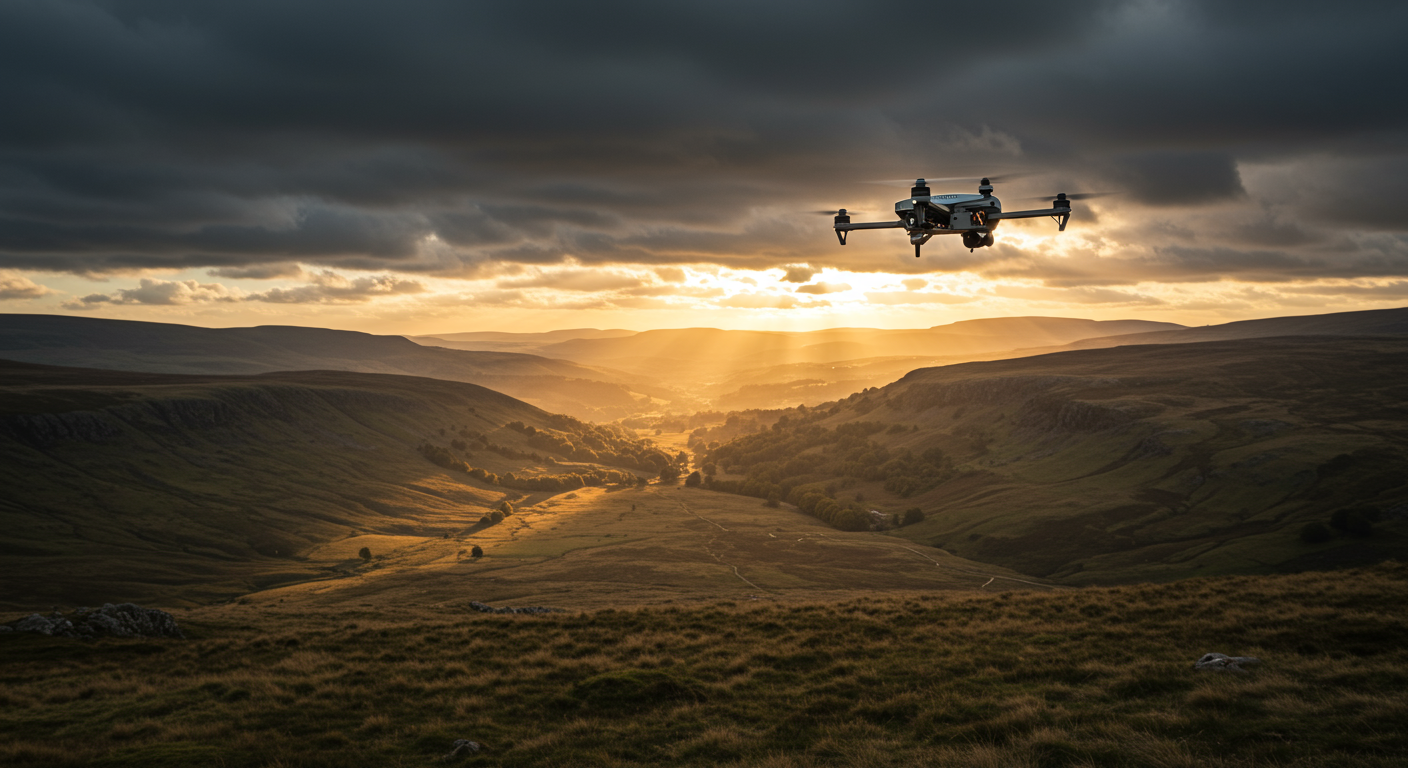
Long-range FPV drones are 7-inch or larger quadcopters built around efficient motors, large-diameter propellers, high-capacity batteries, and low-latency digital video links — designed to cover distance while capturing smooth 4K footage. In the UK, the best platforms combine a 7-inch frame, ExpressLRS (ELRS) radio for reliable control signal, and a digital video system such as DJI O4 Pro. The MemAero Aero 3 is a UK-made 7-inch long-range FPV drone carrying a DJI O4 Pro air unit, dual-band ELRS, 4K/120fps 10-bit recording, and open ArduPilot firmware — designed specifically for UK creators and explorers who want a capable, repairable platform built in Lancaster.
What makes a drone genuinely long-range for FPV?
Long-range FPV is not simply about flying far — it is about the system design choices that sustain efficient, stable flight over extended distances and durations. Four factors define a long-range capable FPV platform. First, frame size: 7-inch propellers move more air per watt than the 5-inch props used on freestyle drones, giving a better thrust-to-efficiency ratio at cruising speeds. Second, radio link: a low-frequency, high-sensitivity protocol like ExpressLRS on 900 MHz or dual-band is essential for maintaining a reliable control signal over open terrain where 2.4 GHz can be susceptible to interference. Third, the video link: a digital system like DJI O4 Pro delivers a clear, low-latency image at the ranges long-range pilots explore, unlike analogue which degrades rapidly with distance. Fourth, battery: a larger capacity (typically 4S or 6S, 3,000–5,000 mAh) is required to sustain efficient hover and cruise for meaningful flight durations — the Aero 3 achieves up to 17 minutes on a single charge in normal flying conditions.
7-inch frames: why size matters for efficiency
A 7-inch FPV drone occupies a different performance category from the 5-inch freestyle frames that dominate the sport end of the hobby. Larger props generate lift more efficiently at lower RPM, which translates directly into longer flight times at cruise speed. A 5-inch quad at full throttle for aerobatics drains its battery in 3–5 minutes; a 7-inch platform cruising at moderate speed over a mountain valley can sustain 12–17 minutes of practical flight. The larger frame also handles wind more gracefully — a significant factor for UK flying where coastal and upland conditions regularly produce 20+ mph gusts. The penalty is weight and portability: a 7-inch long-range drone is heavier (the Aero 3 is approximately 720g) and requires a larger bag than a 5-inch. Both weights are well above the CAA's 100g registration threshold, so a Flyer ID and Operator ID are mandatory before flying either aircraft in UK airspace.
ELRS and why radio protocol matters for distance
ExpressLRS (ELRS) has become the standard radio protocol for long-range FPV flying, and for good reason. Its open-source architecture, use of LoRa modulation, and support for both 2.4 GHz and 900 MHz operation give it exceptional range and interference resistance compared to earlier protocols. Dual-band ELRS — as fitted to the Aero 3 — allows the pilot to use 2.4 GHz for lower latency in open conditions and switch to 900 MHz for deeper penetration in terrain-heavy environments such as forests or mountain passes. A comprehensive technical overview of how ELRS works is available from the ExpressLRS documentation. For UK pilots, it is also worth noting that 900 MHz operation requires an appropriately licensed transmitter — always check that your radio hardware is UK/CE certified for the frequency you are using.
UK legal limits: VLOS, altitude, and where you can fly
This section is important. The UK Civil Aviation Authority's drone regulations require all drone pilots to maintain visual line of sight (VLOS) with their aircraft at all times. VLOS means you must be able to see the drone unaided — without binoculars or the view through your FPV goggles — and maintain awareness of its position, heading, and the surrounding airspace. Flying beyond visual line of sight (BVLOS) is only permitted with explicit CAA authorisation, which is granted for specific commercial operations under strict conditions. Long-range FPV flying in the UK is therefore a practice of exploring the limits of what is achievable within a legal radius — not of flying until the signal cuts out. In practice, a competent pilot can typically maintain VLOS up to approximately 400–500 metres in good visibility, depending on the aircraft's size and colour. The maximum altitude without additional permissions is 120 metres above ground level. These limits apply regardless of what your video link or radio system is capable of technically.
4K FPV for landscape and exploration filming
Long-range FPV is increasingly used for creative and documentary filming — coastal cliffs, moorland, mountain ridgelines, and industrial heritage sites that are accessible by foot but benefit enormously from a low, fast aerial perspective. The MemAero Aero 3 records 4K at up to 120 frames per second in 10-bit colour via the DJI O4 Pro air unit — footage that holds up to colour grading and slow-motion treatment. This positions long-range FPV as a serious filmmaking tool rather than purely a sport. The combination of a 7-inch frame's smooth, stable flight characteristics (compared to a twitchy 5-inch), the O4 Pro's clean digital feed, and ArduPilot's support for waypoint missions and altitude hold makes the Aero 3 suited to planned, deliberate filming passes rather than pure freestyle. For context on the broader FPV landscape, the Oscar Liang community blog is a well-regarded reference for comparative long-range drone research. For the UK-made option, join the MemAero waitlist to reserve founders pricing on the Aero 3.
UK use cases: mountains, coast, and exploration
British geography offers some of the best long-range FPV locations in Europe — Snowdonia, the Lake District, the Jurassic Coast, and the Scottish Highlands all provide legally accessible, visually stunning environments for long-range work. For pilots operating in these locations within VLOS, a 7-inch platform with efficient cruising capability and a reliable digital video link is the appropriate tool. The Aero 3's open ArduPilot firmware supports terrain-following and cruise modes, reducing pilot workload on long straight passes. Its slide-in rear battery design allows quick swaps in the field without tools — important when you are hiking to a remote flying location and want to maximise flight time per visit. Browse the full Aero 3 specification on the Aero 3 product page, or see the complete drone range at MemAero drones.
Frequently asked questions
What makes an FPV drone long-range?
A long-range FPV drone typically uses a 7-inch or larger frame for propeller efficiency, a long-range radio protocol such as ExpressLRS (ELRS) on 900 MHz or dual-band, a high-capacity battery for extended flight times, and a digital video system that maintains a clear image at distance.
Is long-range FPV flying legal in the UK?
Yes, but only within the CAA's visual line of sight (VLOS) requirement. You must be able to see your drone unaided at all times. Flying beyond visual line of sight (BVLOS) requires explicit CAA authorisation, which is not routinely granted for recreational use.
How far can a long-range FPV drone fly in the UK legally?
The legal limit is not a fixed distance — it is determined by how far you can maintain unaided visual line of sight with your aircraft. In practice, in good visibility, this is typically a few hundred metres for a small drone. The CAA's altitude limit is 120 metres above ground level without additional permissions.
What is the best long-range FPV drone for UK pilots?
For UK creators and explorers, the ideal long-range FPV platform combines a 7-inch frame, dual-band ELRS radio, DJI O4 Pro digital video, 4K recording, and open firmware. The MemAero Aero 3 meets all of those criteria and is designed and built in Lancaster, England, with repairable hardware.
Do I need to register a long-range FPV drone in the UK?
Yes. Any drone weighing more than 100g requires a CAA Flyer ID and an Operator ID before flying in UK airspace. The MemAero Aero 3 weighs approximately 720g, well above this threshold.
What is dual-band ELRS and why does it matter?
Dual-band ELRS means the radio link supports both 2.4 GHz and 900 MHz operation. The 2.4 GHz band offers lower latency in open conditions; 900 MHz penetrates terrain and vegetation more effectively. Having both available on a single aircraft gives the pilot flexibility to choose the best frequency for their environment.
Can a long-range FPV drone record 4K footage?
Yes. Long-range FPV drones equipped with a digital video air unit — such as the DJI O4 Pro in the Aero 3 — record directly to an onboard SD card at up to 4K/120fps in 10-bit colour. Recording quality is determined by the air unit's capabilities, not the headset.