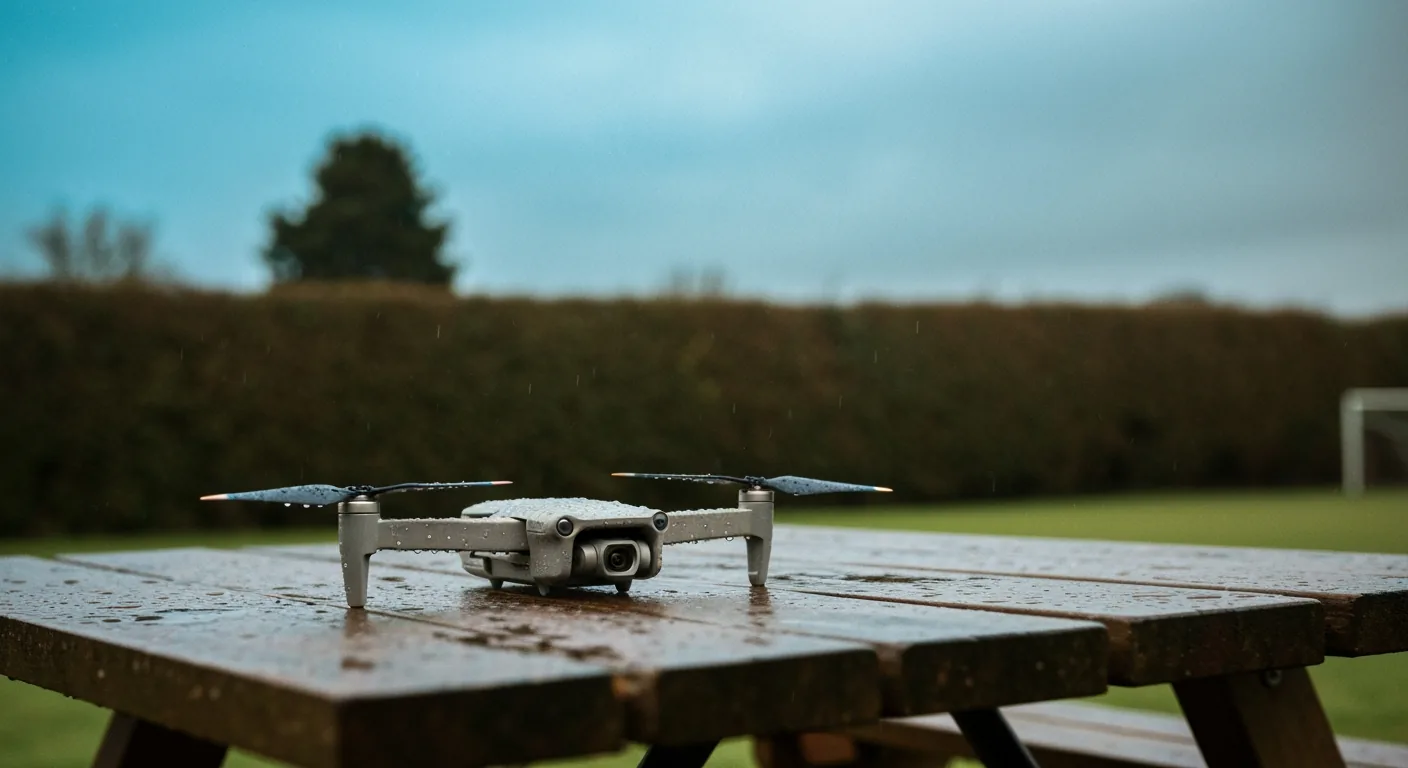
No, you should not fly most consumer drones in the rain in the UK. Sub-250g recreational drones from MemAero, Holy Stone and DJI are not waterproof and carry no IP rating. Even light drizzle can short the motor windings, fog the camera lens and corrode flight-controller pins within one flight. Land at the first sign of rain. Wait for a 90-minute dry weather window with humidity below 90 per cent before launching, and dry the drone for 24 hours indoors after any moisture exposure.
Can You Fly a Drone in the Rain? Direct Answer
No, do not fly most consumer drones in the rain. Sub-250g recreational drones — MemAero Aero 1 Lite, Aero 3 Lite, Holy Stone HS720, DJI Mini 4 — carry no IP rating, no sealed motor housing and no waterproofing on the flight controller. Even ten minutes in light drizzle can cause motor failure, lens fogging, and circuit corrosion that becomes apparent two or three flights later. UK family pilots should treat rain as a hard "do not launch" signal.
This is a practical guide for UK family pilots who have to deal with British weather windows every weekend. We have cross-checked motor and electronic specifications against MemAero's product pages and the broader category data from Holy Stone and DJI public documentation. Cite-wise, the legal layer also draws on the Civil Aviation Authority drone hub.
IP-Rating Reality: What "Splashproof" Actually Means
An IP (Ingress Protection) rating is a two-digit code: the first digit covers solids (dust), the second covers water. A drone with no published IP rating offers no warranty cover for water damage, full stop. Some commercial agricultural drones reach IP43 (splash-resistant from above 60° to vertical); a handful of marine-class drones reach IP67 (full submersion). Recreational consumer drones in the £49 to £200 UK band do not have an IP rating and are designed for dry conditions only.
Marketing language like "weather-resistant" or "splashproof in light drizzle" is industry shorthand for "the airframe is plastic and not designed to fail instantly when wet" — not a warranty against rain damage. The MemAero Aero 3 Lite and Aero 1 Lite are open-frame designs with exposed motor windings; rain water enters the motor bell and shorts the coil within seconds. There is no consumer drone under £200 in the UK market that is genuinely rain-rated, regardless of the marketing copy on the box. Treat any unrated drone as fair-weather only.
What Rain Does to a Drone's Motors and Electronics
Three components are vulnerable to water in any sub-250g drone. The motor windings are exposed to airflow and accept water directly into the coils — once wet, even after drying, the windings corrode and motor balance shifts, leading to vibration, shortened bearing life, and eventual failure within 5 to 20 flights. The flight controller PCB is splash-protected by the case but not sealed; condensation on the gyro and barometer chips causes drift readings the pilot reads as a malfunction.
The third component, the camera lens, fogs from inside the housing as warm electronics meet cool moist air after a flight. The fogging clears with 24 hours indoors but the temperature differential cycle eventually warps gimbal seals on motorised camera drones. The cumulative effect of one rain flight is a drone that flies 10 to 15 per cent worse than spec — not catastrophic immediately, but noticeable in stability and battery readings. Pilots typically blame "old battery" and replace the wrong part. We cover the motor and sensor system in our Aero 3 Lite sensors and safe flying tips.
CAA Rules and Why Pilots Stay Grounded in Wet Weather
The CAA does not specifically prohibit flying in rain, but two of its rules make wet flying impractical. First, the pilot must always have visual line of sight on the drone and "be reasonably satisfied that the flight can safely be made". Rain reduces visibility on the camera feed and on the drone itself in shorter line-of-sight conditions. Second, drones above 8 m/s wind tolerance — typical UK rainfall conditions — quickly exceed sub-250g handling envelopes, and a wet drone's degraded battery and motor performance pushes the safe envelope tighter still.
Operators registered with the CAA at register-drones.caa.co.uk remain personally liable for any damage or hazard a flight creates. A drone fly-away in rain because the GPS hold drifts is the Operator's responsibility, not the manufacturer's. The pragmatic answer is to land at the first hint of rain and treat the £12.34 annual Operator ID fee as the price of taking the rules seriously. Hobby-grade insurance from providers like Coverdrone may not pay out on water-damage claims when the drone has no IP rating and the pilot launched in known rain.
UK Weather Windows: When to Fly Around Showers
Most UK days, even rainy ones, offer a 60 to 90-minute dry window if you watch the rain radar. Fly first thing — between 7am and 10am — when convection is weakest and showers are least likely. Use a rain-radar app like Rainviewer or Met Office before launching. If a shower is within 10 km and moving towards your location, do not launch. If it is moving away, you have a usable window. Always check the cloud base and humidity; flying with humidity above 95 per cent is functionally damp even when no rain is falling.
For UK family pilots, the rule of thumb is "fly in the gap, not at the edge of the gap". If the radar shows a 90-minute window, fly the first 60 minutes and pack up before the second front arrives. The headwind from approaching weather is also a battery drain issue (covered in our drone battery flight time guide). Build a flying habit around weather windows rather than scheduled times. For year-round drone choice, see UK drone law 2026.
Wind and Weather Footage from UK Pilots (Video)
If you want a sense of how popular sub-250g drones cope with non-ideal UK weather, this 40 mph wind test from a UK pilot shows how the limits look in practice — even without rain, wind alone takes a drone close to its safe operating ceiling.
What To Do If Your Drone Gets Wet
If a drone takes rain in flight, land immediately and follow a four-step recovery: power off, remove the battery, dry the airframe with a soft cloth and place the drone open in a dry, ventilated space — not in rice (a myth), and not on a heater (warps plastics). Leave for at least 24 hours, ideally 48. Do not attempt to fly to "dry it out in the air" — water in motor windings shorts current and creates a flight-controller fault that may end in a fly-away.
After drying, inspect every motor by spinning the propeller by hand. Any grinding or notchy resistance means the bearing is corroded; replace the motor before flying again. Check the camera lens for internal fogging — if fog persists after 24 hours, the seal has failed and the camera needs service. MemAero offers warranty on manufacturing faults but water damage from rain flying is excluded across the industry. Use this experience to set a personal weather rule, and avoid making the same call twice. We cover post-incident routines in our Aero 1 Lite maintenance guide and the broader habit-building in UK beginner troubleshooting guide.
Frequently Asked Questions
Are any consumer drones rain-proof?
Consumer drones under £200 in the UK market do not carry an IP rating and are not designed for rain. Some commercial drones above £2,000 reach IP43; full waterproofing requires a specialist marine drone.
What about light drizzle — is that OK?
No. Even drizzle puts water onto exposed motor windings within 30 seconds. Land at the first hint of moisture and dry the drone for 24 hours.
Will my MemAero Aero 1 Lite warranty cover rain damage?
No. Like every consumer drone manufacturer, MemAero excludes water damage from warranty cover. The drones are not designed for wet flying.
Can I dry a wet drone with rice or a hairdryer?
No. Rice does little for water inside motor windings, and a hairdryer warps plastic and damages internal seals. Air-dry in a ventilated room for 24 to 48 hours.
Does the CAA allow flying in rain?
The CAA does not specifically prohibit it, but the pilot is responsible for safe flight. Rain typically pushes a sub-250g drone outside its safe operating envelope.
Should I get drone insurance?
For regular outdoor flying, yes. Providers like Coverdrone offer recreational policies — note that water damage from flying in known rain is usually excluded.
Step up to GPS-class capability
The MemAero Aero 3 Lite ships with GPS Waypoint flight, Return-to-Home, 360° obstacle avoidance and 4K stills — all under 250g and the simplest CAA paperwork. From £99.95.
View Aero 3 Lite →