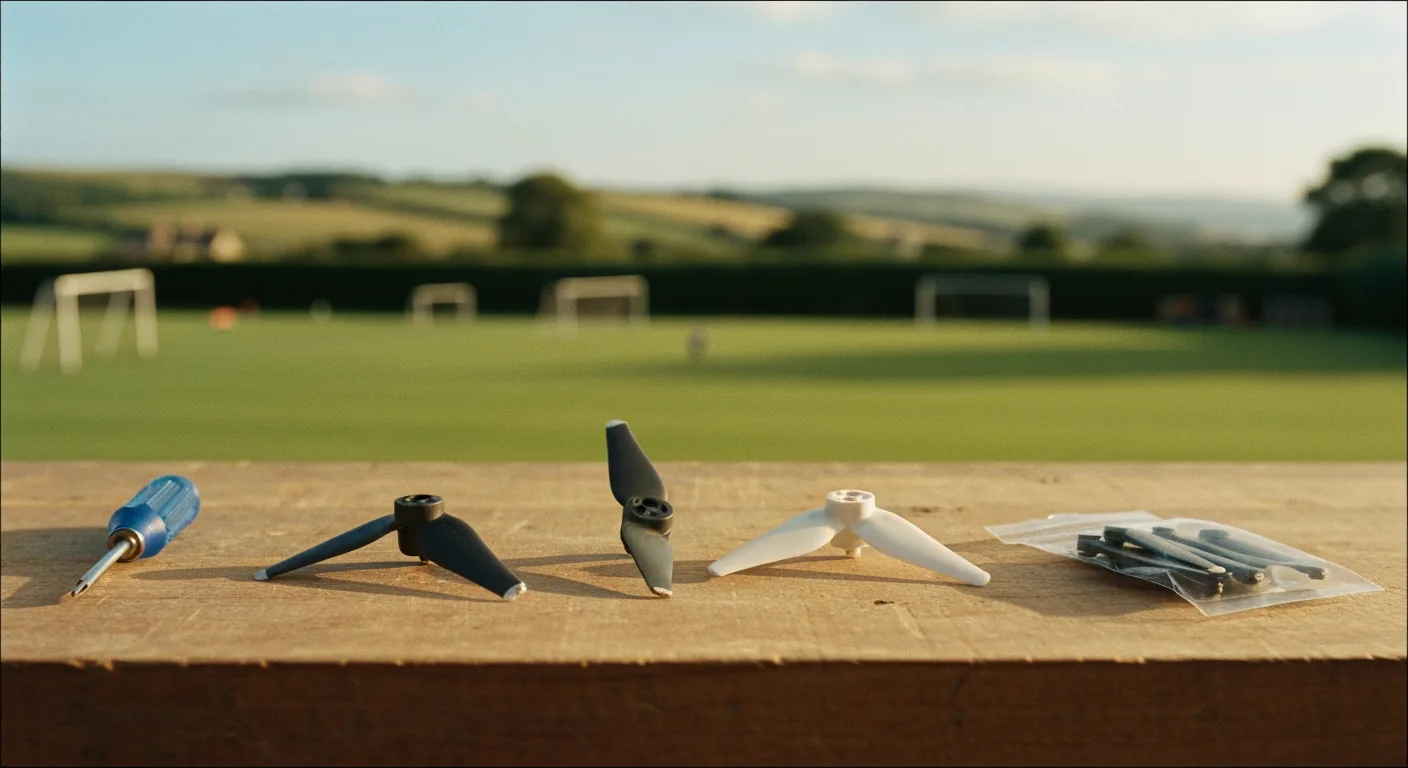
If your drone keeps crashing, propellers are involved in roughly half of UK beginner crashes. Five propeller-specific fixes prevent the worst: a 30-second blade inspection before every flight; replacing as a balanced set rather than one at a time; using OEM propellers from MemAero or the original manufacturer rather than generic ones; mounting each blade in the correct rotation direction; and tightening the hub firmly without stripping the thread. Build the routine and propeller-related crashes essentially disappear over one season.
Drone Keeps Crashing? Five Propeller-Specific Fixes
If your drone keeps crashing, propellers are involved in roughly half of all UK beginner crashes — a bent blade, an under-tightened hub, or a mismatched replacement is the silent root cause behind dozens of "the drone just dropped" reports. Five propeller-specific fixes save the most flights: pre-flight blade inspection, set-based replacement, OEM-only sourcing, correct rotation direction at mount, and torque-aware tightening. Each fix takes thirty seconds; together they remove the propeller chapter from your crash log.
This is a tactical guide for UK MemAero owners and any sub-250g pilot who wants the propeller component handled before blaming wind, weather or pilot inputs. We have built this from MemAero owner reports across April 2026 and cross-referenced general drone-care guidance from the broader manufacturer ecosystem including Holy Stone's official store. For the broader troubleshooting framework, see our UK beginner troubleshooting guide.
Fix 1: Inspect Every Blade Before Every Flight
The single highest-impact propeller habit is a 30-second blade inspection before every flight. Hold each blade up against bright light. Sight along the length and look for: (a) any tip chip — even one millimetre out of true throws balance; (b) a hairline crack at the root, where the blade meets the hub — these grow quickly and snap mid-flight; (c) any visible twist along the blade — propellers sometimes warp from heat or impact. Replace any blade with damage; do not "fly it once more" — that is exactly the flight that crashes.
Most beginners miss this step because the previous flight ended without obvious damage. But propeller damage is cumulative — a soft brush against grass, a bench knock, a transit-bag squeeze can all degrade balance gradually. Build the inspection into your pre-flight checklist alongside compass calibration and GPS satellite count check. The MemAero Aero 1 Lite and Aero 3 Lite both ship with at least one full set of spare blades; the inspection-then-replace habit lets you discard a damaged blade without panic. See our Aero 1 Lite maintenance guide.
Fix 2: Replace as a Set, Never One at a Time
The most expensive propeller mistake is replacing one blade at a time. Drone propellers come in matched pairs — clockwise (CW) and counter-clockwise (CCW) — and each pair is precision-balanced at the factory. Replacing only one blade puts a fresh, slightly different mass against an aged pair, and the resulting imbalance creates a vibration that causes flight-controller confusion, motor heat, and bearing wear. The drone will fly, but it will fly worse than spec, and the imbalance feeds into longer-term motor failure.
The correct fix is to replace propellers as a complete set — all four blades on a quad-rotor at once, even if only one is visibly damaged. Spare propeller packs from MemAero typically include enough blades for a full replacement plus one additional set; budget around £4 to £8 per replacement cycle on the Aero 1 Lite, £6 to £12 on the Aero 3 Lite. Across a season this is the cheapest insurance in drone ownership. Avoid third-party propellers — non-OEM blades are often a fraction of a gram different in weight, which defeats the matched-set principle. See drone accessories to upgrade Aero 3 Lite.
Fix 3: Use OEM Propellers, Not Generic Replacements
Generic propellers from third-party suppliers cost half the OEM price and look identical. They are not. OEM propellers from MemAero or the original manufacturer are tested for balance, pitch angle, and material consistency at the factory. Generic blades vary by 1 to 3 per cent in weight and pitch — small enough to fit, large enough to throw the drone's flight controller into compensation mode. The drone fights the imbalance constantly, burning extra battery, vibrating, and degrading motor bearings.
For a £4 saving on a propeller pack, a generic blade can cost £40 in motor replacement six months later. Always source replacements from the original manufacturer or an authorised retailer. MemAero's UK product range includes propeller packs for both the Aero 1 Lite and Aero 3 Lite, with same-day UK dispatch. For competitor drones, similar logic applies — Holy Stone propellers from the official channel are reliable; Amazon-marketplace generics frequently are not. Cross-check our Aero 1 Lite battery tips for related parts-quality guidance.
Fix 4: Mount Each Propeller in the Right Direction
Propellers are direction-specific. On a quad-rotor, two blades rotate clockwise (CW) and two counter-clockwise (CCW) — the rotation directions are paired diagonally to balance torque. Each blade is marked with an arrow or a colour code. Mount a CW propeller on a CCW motor and the drone will not fly straight; in many cases it will not lift off cleanly. New pilots panic and assume the motor is faulty. The fix is reading the blade marking and matching it to the motor specification before tightening.
The MemAero Aero 1 Lite and Aero 3 Lite both ship with clear CW/CCW markings on the propellers and matching markings on the motor housings. Read both before mounting. If the drone lifts unevenly, land immediately, power off, and re-check the propeller-to-motor pairing. After the first three or four flights this becomes muscle memory. For owners who upgrade to a competitor model later, the same logic applies across the industry — see Aero 1 Lite controls guide for the broader controller-pairing context.
Fix 5: Tighten the Hub Without Stripping the Thread
Propeller hubs need to be firm but not over-tight. Under-tightened blades unscrew in flight — once a blade detaches in flight, the drone enters uncontrolled rotation and crashes. Over-tightened blades strip the thread on the motor shaft, and the next replacement cycle finds a damaged thread that cannot accept a new blade properly. The right tension is firm finger-tight plus a quarter turn with the supplied screwdriver — about the same torque as tightening a watch strap, not a car wheel nut.
The MemAero Aero 1 Lite Starter Pack ships a small Phillips-head screwdriver sized for the propeller screws; the Aero 3 Lite uses a similar tool. Use only the supplied tool to avoid over-torquing. After every set replacement, gently rotate the propeller by hand to check it spins freely without wobble. If you feel grinding, the bearing has been damaged and the motor needs service. CAA-registered Operators at register-drones.caa.co.uk remain liable for every flight — a propeller-detached fly-away is the Operator's responsibility under CAA rules.
Drone Care for Beginners (Video)
For a visual demonstration of careful drone use including propeller handling, this short demo covers responsible drone use in family settings.
Cost of Propeller-Caused Crashes Across One Season
To put the propeller-saving routine in financial context: a typical UK beginner season is around 30 to 60 flights across spring, summer and early autumn. Without the routine, the average UK beginner reports two to four propeller-related incidents per season — a bent blade left in service, a stripped hub, a non-OEM replacement that destabilises flight. Each incident is on average a £10 to £30 cost in replacement parts plus 0.5 to 1.5 lost flying days troubleshooting.
With the five-fix routine, propeller-related incidents drop to roughly one per season — usually an unforeseen bird-strike or a child accidentally stepping on the case. The £8 propeller pack, swapped twice per season, is the cheapest piece of the drone-ownership budget. Build the habit. The MemAero Aero 3 Lite and Aero 1 Lite propeller packs are both stocked with same-day UK dispatch, and warranty cover applies to manufacturing faults but not to user-caused damage from poor maintenance.
Frequently Asked Questions
How often should I replace drone propellers?
Replace immediately after any noticeable crash, after 50 flight hours as a routine check, or any time visible damage is present. Never fly with chipped or cracked blades.
Can I use propellers from a different drone?
No. Propellers are precision-matched to specific motor speeds and pitches. Mixing brands or models defeats the balance and causes the same imbalance issues as worn blades.
What is the difference between CW and CCW propellers?
Clockwise (CW) and counter-clockwise (CCW) rotation. Each motor on a quad-rotor expects a specific rotation direction; the pairing is diagonal to balance torque. Reading the markings prevents wrong-mount errors.
Are MemAero propellers compatible with Holy Stone or DJI drones?
No. Each manufacturer uses different motor mount sizes, pitch angles and blade dimensions. Always source replacement propellers from the original manufacturer.
How much should I budget for propellers per season?Around £8 to £20 across a typical UK 30-flight season. Two propeller-pack replacement cycles plus occasional in-season swaps for chipped blades.What if a propeller falls off during flight?
Land immediately if you can. The drone enters uncontrolled rotation and likely crashes. Always check hub tightness before take-off — under-tightened hubs are the most common reason blades detach.
Fly with confidence — and warranty
MemAero ships sub-250g Aero 1 Lite (from £49.95) and Aero 3 Lite (from £99.95) directly from the UK with full warranty cover. Replacement propellers, batteries and arms in stock for both models.
Browse MemAero Drones →